

Introduction
South Asia and the Islamic World have always been deeply connected with gold. From the grandeur of the Mughal Empire to the circulation of the Islamic Dinar and Dirham, gold has not only been a symbol of beauty but also an essential pillar of trade, culture, and religion. Unlike other regions where gold was often reserved for kings, in the Islamic world and South Asia it became part of daily life, influencing weddings, festivals, trade, and spiritual practices.
Gold in South Asia – The Golden Bird
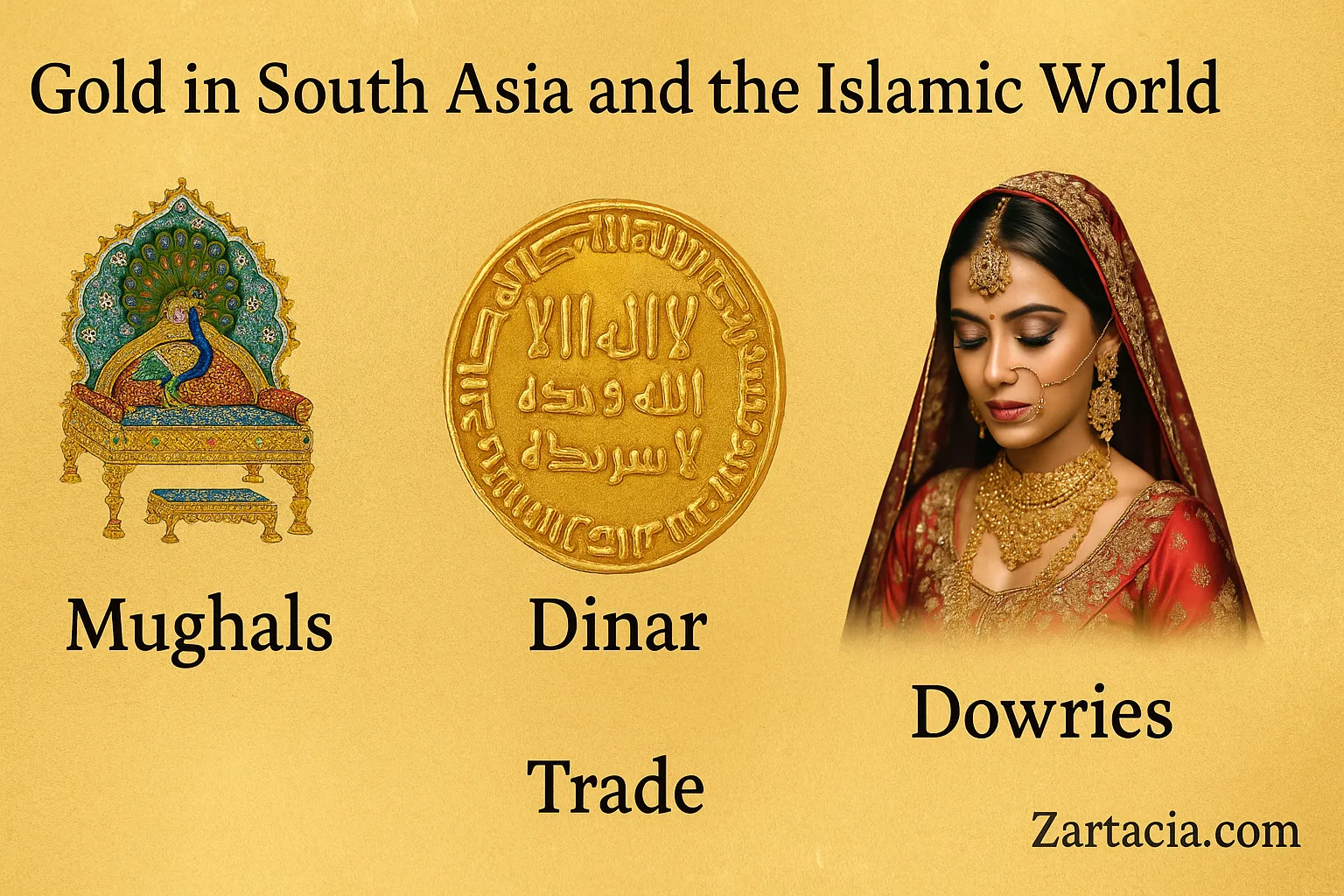
South Asia has long been known as the “Golden Bird” because of its vast gold treasures and cultural use.
-
Mughal Empire: The Mughal emperors filled their treasuries with golden coins, thrones, and jewelry. The famous Peacock Throne was one of the most extravagant golden artifacts in history.
-
Indian Subcontinent: Gold jewelry became an integral part of weddings and dowries. Even today, brides in India and Pakistan wear heavy sets of gold jewelry as a sign of prosperity.
-
Temples & Palaces: Temples in South Asia often stored massive gold ornaments donated by kings and devotees.
-
British Colonization: The British looted tons of gold from South Asia, transferring immense wealth to Europe.
👉 South Asia’s identity as a land of gold was not just cultural but also economic and political.
Gold in the Islamic World – The Dinar and Trade
Islamic civilization gave gold a new meaning — one that balanced wealth with responsibility.
-
The Gold Dinar: Introduced during the Umayyad Caliphate, it became the standard Islamic currency.
-
Trade Networks: Gold fueled trade from Arabia to Africa, Spain, and India, making the Islamic world a hub of global commerce.
-
Zakat on Gold: Islam introduced rules on hoarding and charity. Wealthy Muslims were required to pay zakat on gold, ensuring circulation and fairness.
-
Cultural Symbolism: While gold was allowed for women as adornment, it was prohibited for men in jewelry, reflecting modesty and discipline.
👉 In Islam, gold was not just wealth — it was a test of ethics and responsibility.
South Asia and Islam – A Shared Golden Heritage
South Asia and the Islamic World were connected through gold in trade, culture, and religion.
-
Muslim rulers in South Asia minted gold coins based on Islamic standards.
-
Gold flowed through trade routes connecting Baghdad, Delhi, and Istanbul.
-
Islamic teachings shaped how South Asians used and valued gold.
-
The fusion of South Asian tradition and Islamic ethics created a unique golden culture.
Gold in Daily Life and Traditions
-
Weddings: Gold jewelry is still the most important part of bridal dowries in Pakistan, India, and Bangladesh.
-
Festivals: Eid and other Islamic celebrations often include gifts of gold.
-
Savings: In rural South Asia, families often save wealth in the form of gold jewelry rather than banks.
-
Inheritance: Islamic laws ensure fair distribution of gold among heirs.
👉 Gold continues to be both a cultural necessity and a religious responsibility.
Gold as a Connector of Civilizations
Moreover, gold connected South Asia with the wider Islamic world. In addition to trade, it also served as a cultural bridge, as Islamic values blended with South Asian traditions. For example, the dowry system in India was reshaped under Islamic influence. As a result, gold became both a social and spiritual symbol across the region.
Lessons from Islamic Ethics
On the other hand, Islamic teachings placed limits on gold usage. Men were restricted from wearing gold, but women were encouraged to use it as adornment. Therefore, gold became a balance of beauty and discipline. As a result, this ethical framework kept gold from being misused.
The Lasting Legacy of Gold in South Asia
In addition, South Asia’s title as the “Golden Bird” still echoes in modern times. Even today, the region remains one of the largest consumers of gold. Consequently, its legacy continues to shape global gold demand, proving that the bond between South Asia and gold is unbreakable.
Conclusion
The story of gold in South Asia and the Islamic World is one of wealth, culture, and faith. From Mughal thrones to Islamic Dinars, from temples to wedding dowries, gold has shaped societies and guided traditions. It remains both a treasure of the past and a foundation for the present.
FAQs
Q1. Why was South Asia called the “Golden Bird”?
Because of its immense gold wealth and treasures during ancient and Mughal times.
Q2. What was the Islamic Dinar?
A gold coin introduced in the Umayyad period, used across the Islamic world for trade.
Q3. Why is gold important in South Asian weddings?
It symbolizes prosperity, beauty, and financial security for brides.
Q4. How does Islam regulate the use of gold?
It allows women to wear gold but prohibits men from using it as jewelry. Zakat is also required.
Q5. How did British colonization affect South Asia’s gold?
The British looted massive amounts of gold, weakening South Asia’s economy.
🟢 Internal Linking Suggestions
-
Link to “Discovery and Use of Gold in Ancient Civilizations” (Article no 12)
-
Link to “Religious and Jurisprudential Aspects of Gold” (Article no 6)
🟢 External Linking Suggestions
🟢 Video Link
Gold in the Islamic World and South Asia | History Documentary
