
Introduction
Gold as a Universal Religious Symbol
Gold appears in nearly every major religion as a sign of wealth, purity, and divine blessing. From ancient scriptures to modern rituals, gold reflects both material value and spiritual significance.
Interfaith Parallels in Gold Usage
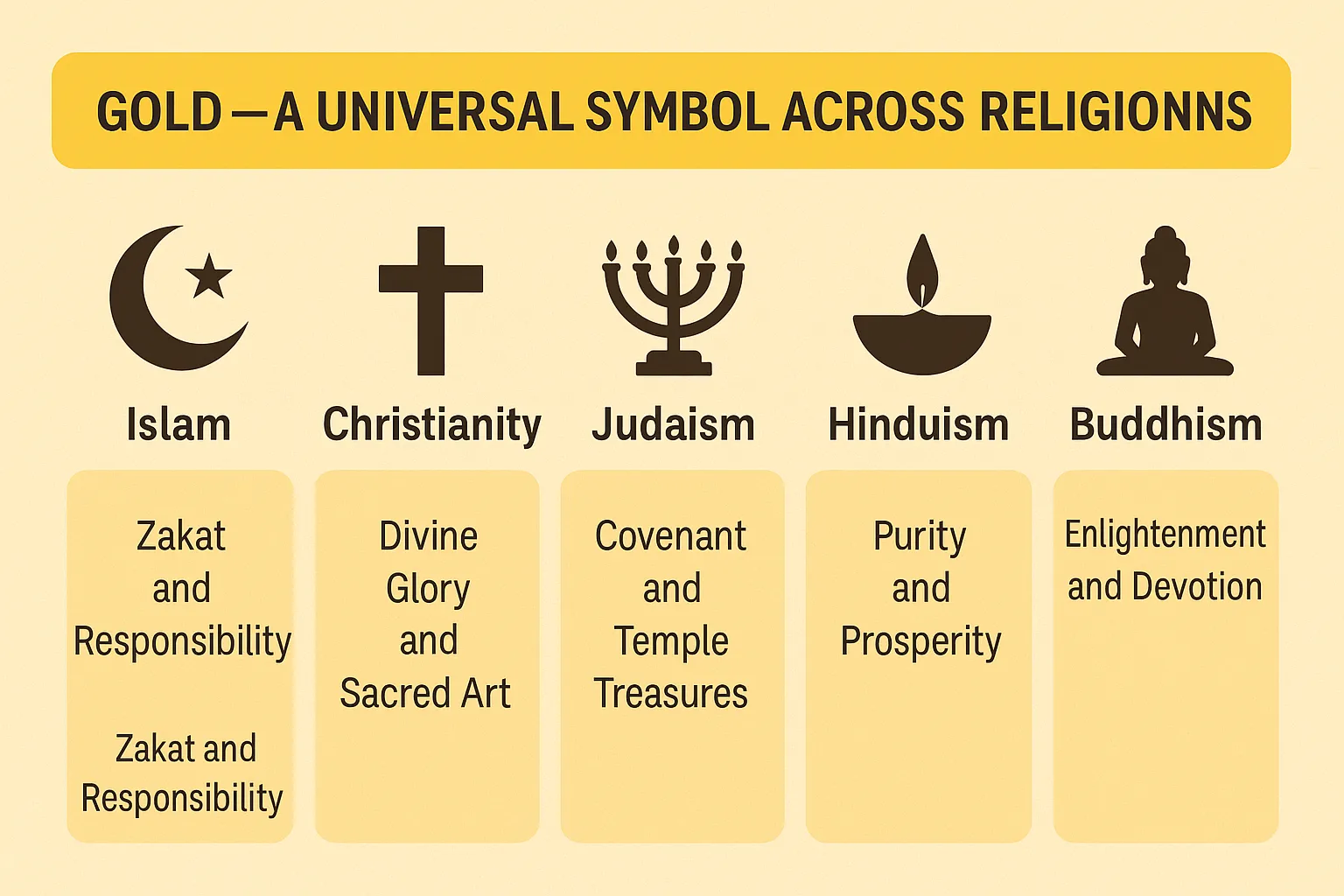
Although each religion views gold differently, all connect it to concepts of purity, sacredness, and prosperity. Islam emphasizes responsibility and Zakat, Christianity highlights divine glory, Judaism links it to covenant, Hinduism treats it as auspicious, and Buddhism connects it to enlightenment.
Purpose of This Article
This article provides a comparative overview of how Islam, Christianity, Judaism, Hinduism, and Buddhism interpret and use gold. Moreover, it highlights similarities and differences that reveal the universal role of this precious metal.
Gold in Islam – Responsibility and Purification
Islam treats gold as both a blessing and a test. Muslims may use it for jewelry and trade, but hoarding without Zakat leads to sin. Therefore, Zakat ensures circulation of wealth and prevents arrogance. Simplicity is encouraged, while extravagance is discouraged.
Gold in Christianity – Divine Glory and Sacred Art
Christianity associates gold with divine presence. Churches and cathedrals often contain golden chalices, altars, and mosaics. Moreover, the Bible describes heaven with streets of pure gold, showing eternal glory. Gold thus becomes a bridge between material beauty and spiritual faith.
Gold in Judaism – Temple Treasures and Covenant
Judaism highlights gold in the Temple of Jerusalem, where the Ark of the Covenant and Menorah were crafted in gold. In addition, Jewish traditions use gold in synagogues, marriage customs, and festivals like Hanukkah. For Jews, gold represents holiness, purity, and God’s eternal covenant.
Gold in Hinduism – Purity and Prosperity
Hinduism regards gold as auspicious and linked to Goddess Lakshmi. Families buy gold during Diwali and Akshaya Tritiya as a symbol of fortune. Furthermore, temples like Tirupati Balaji and Padmanabhaswamy hold massive gold treasures offered by devotees. Weddings also feature gold jewelry, symbolizing purity and lifelong prosperity.
Gold in Buddhism – Enlightenment and Devotion
Buddhism treats gold as a symbol of enlightenment and spiritual perfection. Golden temples and Buddha statues remind devotees of wisdom and inner peace. Moreover, pilgrims actively donate gold leaves to pagodas, proving that gold functions as an offering of faith rather than a display of wealth.
Comparative Insights – Similarities and Differences
-
Similarities: All religions connect gold with purity, prosperity, or divinity. Rituals, festivals, and sacred objects across traditions include gold.
-
Differences: Islam emphasizes responsibility and Zakat, Christianity and Judaism highlight sacredness in worship, Hinduism links it to prosperity, and Buddhism treats it as spiritual symbolism.
📚 Student Section
🔹 Summary
-
Gold is universal in religion.
-
Islam: Zakat and responsibility.
-
Christianity: Divine glory.
-
Judaism: Covenant and Temple treasures.
-
Hinduism: Prosperity and auspiciousness.
-
Buddhism: Enlightenment and faith.
🔹 Quiz
-
What role does Zakat play in Islam’s use of gold?
-
How is gold described in Christianity’s vision of heaven?
-
Which Jewish treasures were made of gold?
-
Why is gold considered auspicious in Hinduism?
-
How do Buddhists use gold in temples?
🔹 Difficult Words with Urdu Meanings
| Word | Meaning (Urdu) |
|---|---|
| Covenant | عہد – وعدہ یا معاہدہ |
| Auspicious | نیک شگون – مبارک |
| Enlightenment | بیداری – روحانی روشنی |
| Extravagance | فضول خرچی – اسراف |
| Prosperity | خوشحالی – ترقی |
❓ FAQs
Q1: Which religions use gold in temples and rituals?
Ans: Islam, Christianity, Judaism, Hinduism, and Buddhism.
Q2: What is the common symbolism of gold across faiths?
Ans: Purity, prosperity, and divine presence.
Q3: How is Islam’s view of gold different?
Ans: Islam requires Zakat and discourages extravagance.
Q4: Why do Hindu families buy gold on Akshaya Tritiya?
Ans: It is considered auspicious and brings prosperity.
Q5: How do Buddhists use gold in temples?
Ans: By decorating statues and stupas with gold leaf donations.
🔗 Internal Linking Suggestions
-
Link to Article 29: Gold in Judaism – Temple Treasures and Symbolism
-
Link to Article 30: Gold in Hinduism – Traditions and Rituals
-
Link to Article 31: Gold in Buddhism – Symbolism and Traditions
🔗 External Linking Suggestions
Conclusion
Across religions, gold shines not only as wealth but as a universal spiritual symbol. Islam highlights responsibility, Christianity and Judaism emphasize holiness, Hinduism links it to prosperity, and Buddhism connects it to enlightenment. Despite differences, all faiths recognize that gold carries a deeper meaning beyond material value.
