
Introduction
Gold as a Unique Precious Metal
Gold is one of the most fascinating elements in nature. Scientists value it not only for its beauty but also for its unique chemical and physical properties. Unlike many metals, gold resists corrosion and maintains its shine for centuries.
Importance of Studying Gold Scientifically
Understanding gold’s properties helps explain why it has remained valuable for thousands of years. Moreover, its chemical stability and physical strength make it useful in jewelry, medicine, and modern technology.
Purpose of This Article
This article explores the atomic structure, chemical behavior, physical characteristics, and industrial applications of gold. By examining these features, we can better appreciate why gold remains one of the world’s most extraordinary elements.
Atomic Structure of Gold – Element Number 79
-
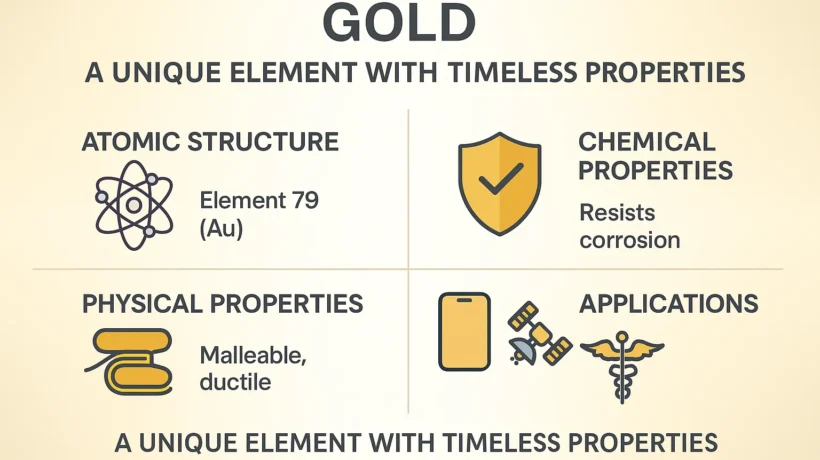
Gold has an atomic number of 79 and is represented by the symbol Au.
-
It belongs to the transition metals in the periodic table.
-
Moreover, it has one of the most stable electron configurations, giving it durability and resistance to corrosion.
Chemical Properties of Gold – Stability and Reactivity
-
Gold is chemically inert, meaning it does not easily react with oxygen or moisture.
-
It does not rust, unlike iron, and does not tarnish like silver.
-
Furthermore, it dissolves only in special solutions like aqua regia (a mix of hydrochloric and nitric acid).
-
This stability explains why ancient gold artifacts remain preserved even today.
Physical Properties of Gold – Strength and Shine
-
Gold is a soft, malleable, and ductile metal, meaning it can be beaten into thin sheets or drawn into wires.
-
It is also an excellent conductor of heat and electricity, which is why it is used in electronics.
-
Moreover, gold reflects light beautifully, giving it a natural brilliance that makes it ideal for jewelry and decoration.
Density and Melting Point of Gold
-
Gold is extremely dense, with a density of 19.3 g/cm³.
-
Its melting point is 1,064°C (1,947°F), making it durable in extreme conditions.
-
Therefore, it is used in aerospace, electronics, and high-temperature industries.
Modern Applications of Gold Based on Properties
-
Electronics: Conductivity makes gold valuable in smartphones and computers.
-
Medicine: Gold nanoparticles are used in cancer treatment and diagnostics.
-
Space Technology: Satellites use gold coatings for radiation protection.
-
Jewelry: Malleability ensures gold remains the most popular ornamental metal.
📚 Student Section
🔹 Summary
-
Gold = Atomic number 79, symbol Au.
-
Chemically stable, resists rust and tarnish.
-
Malleable, ductile, excellent conductor.
-
Density 19.3 g/cm³, melting point 1,064°C.
-
Applications: electronics, medicine, space, jewelry.
🔹 Quiz
-
What is the atomic number of gold?
-
Which solution can dissolve gold?
-
Why does gold not rust like iron?
-
What is gold’s melting point?
-
Name two modern applications of gold.
🔹 Difficult Words with Urdu Meanings
| Word | Meaning (Urdu) |
|---|---|
| Inert | غیر فعال – کم ردعمل والا |
| Malleable | پھیلنے والا – موڑنے کے قابل |
| Ductile | لمبا کھنچنے کے قابل |
| Density | کثافت – وزن فی حجم |
| Corrosion | زنگ لگنا – دھات کا خراب ہونا |
❓ FAQs
Q1: Why does gold not rust?
Ans: Because it is chemically inert and resists oxidation.
Q2: What is aqua regia?
Ans: A mixture of acids that can dissolve gold.
Q3: Why is gold used in electronics?
Ans: Because it conducts electricity and does not corrode.
Q4: What makes gold ideal for jewelry?
Ans: Its malleability, ductility, and natural shine.
Q5: How does gold help in medicine?
Ans: Gold nanoparticles assist in cancer treatment and diagnostics.
🔗 Internal Linking Suggestions
-
Link to Article 21: Zakat on Gold – Calculation and Nisab (scientific vs religious angle)
-
Link to Article 26: Practical Modern Examples of Gold Zakat
-
Link to Article 32: Interfaith Comparison of Gold Usage
🔗 External Linking Suggestions
🌟 Conclusion
Gold is not just a decorative metal; it is a scientifically remarkable element. Its chemical stability, physical brilliance, and unique properties make it valuable in technology, medicine, and culture. By combining science with tradition, gold continues to shine as one of humanity’s most extraordinary discoveries.