
Introduction
Web servers are the backbone of the internet, serving billions of web pages every day. Among the many options available, Apache and Nginx are the two most popular choices worldwide. Both are powerful, open-source, and widely supported, but they work differently and are suitable for different needs.
Apache has been the industry leader for decades. It is flexible, highly configurable, and powers millions of websites. Nginx, on the other hand, was built for speed and efficiency, handling thousands of connections simultaneously with lower resource usage.
In this class, we will explore Apache and Nginx, their features, differences, and use cases. You will also learn how they can be combined in a hybrid setup for maximum performance.
Apache Web Server
Apache HTTP Server, developed in 1995, is one of the oldest and most reliable web servers. Its modular design allows administrators to load or unload features depending on requirements.
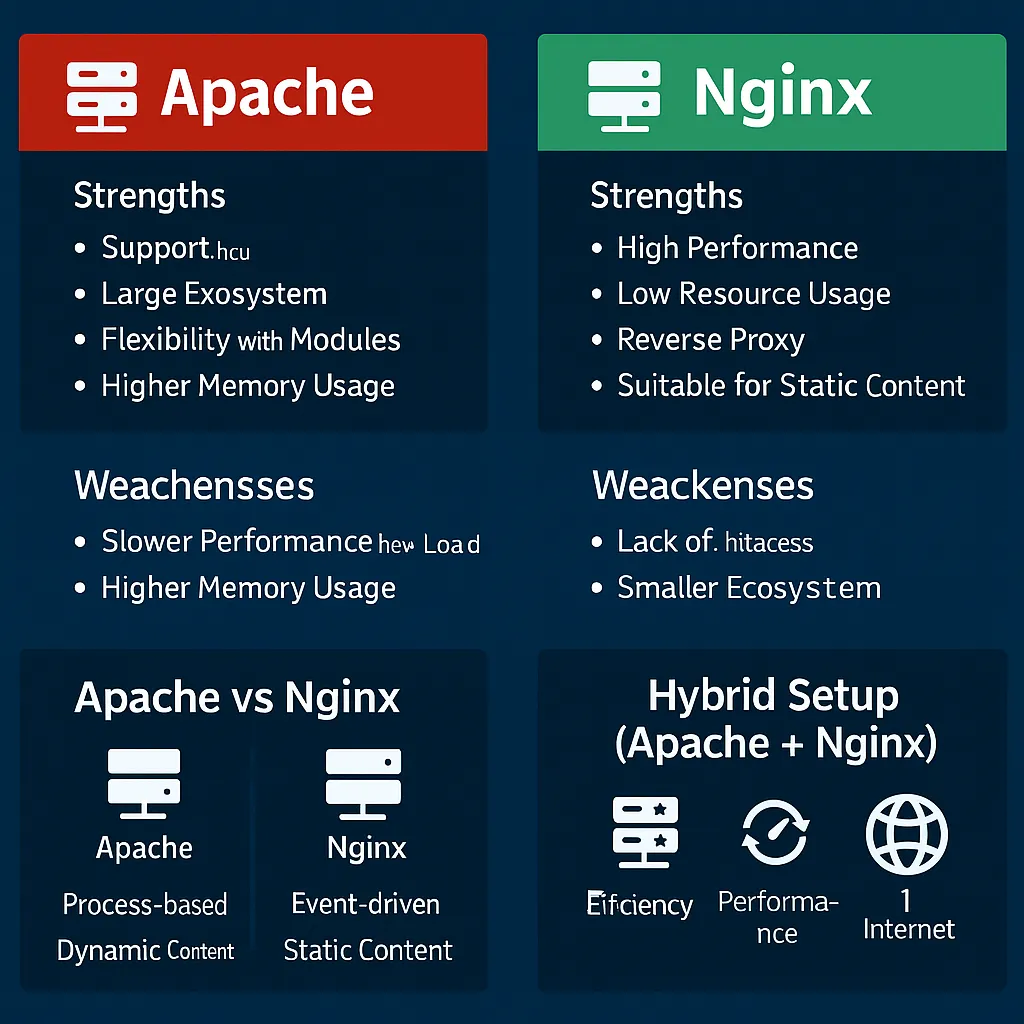
Strengths of Apache:
-
Supports
.htaccessfor directory-level configuration -
Large community and documentation
-
Compatible with most CMS platforms like WordPress, Joomla, and Drupal
-
Flexible modules for security, caching, and authentication
Limitations of Apache:
-
Slower than Nginx in handling large traffic
-
Higher memory usage with thousands of concurrent connections
Nginx Web Server
Nginx (pronounced “Engine-X”) was created in 2004 to solve the problem of handling heavy traffic. Unlike Apache, Nginx uses an event-driven architecture, allowing it to manage thousands of requests with minimal resources.
Strengths of Nginx:
-
High performance under heavy load
-
Efficient reverse proxy and load balancing
-
Lower memory consumption
-
Great for static content delivery (HTML, images, CSS, JS)
Limitations of Nginx:
-
Does not support
.htaccess(requires centralized config) -
Smaller ecosystem compared to Apache
Apache vs Nginx – Key Differences
-
Architecture: Apache uses process/thread-based handling, while Nginx is event-driven.
-
Performance: Nginx is faster for static files, Apache excels with dynamic content.
-
Configuration: Apache allows
.htaccess, Nginx requires central configuration files. -
Use Cases: Apache is beginner-friendly and CMS-focused, Nginx is preferred for high-traffic sites.
Many companies combine both: Nginx as a reverse proxy to handle static content and load balancing, while Apache processes dynamic content like PHP.
Practical Task
-
Install Apache on a Linux server and host a test HTML page.
-
Install Nginx on another server and test static file performance.
-
Compare resource usage using the
topcommand.
Student Section
Summary (150 words):
Apache and Nginx are the two leading web servers. Apache is flexible, widely supported, and works seamlessly with CMS platforms. It allows easy configuration with .htaccess. Nginx is lightweight and event-driven, making it better for high-traffic environments. While Apache consumes more memory, it is easier to configure. Nginx shines in handling static content, load balancing, and reverse proxy setups. Many organizations use both together for maximum efficiency: Nginx manages traffic and static files, while Apache handles PHP and dynamic content. Knowing the strengths and weaknesses of each server helps administrators choose the best setup for their projects.
Quiz:
-
Which web server is older, Apache or Nginx?
-
What does
.htaccessdo in Apache? -
Why is Nginx faster under heavy traffic?
-
Which server is better for static files?
-
Can Apache and Nginx be used together?
Difficult Words Table:
| Word | Meaning in Urdu |
|---|---|
| Modular | ماڈیول پر مبنی / حصوں میں |
| Reverse Proxy | الٹا پراکسی / ٹریفک کنٹرول |
| Concurrent | بیک وقت / ایک ساتھ |
| Ecosystem | نظام یا ماحول |
| Configuration | ترتیب دینا |
FAQs
Q1: Is Apache still relevant in 2025?
Yes, Apache is still widely used for millions of websites and CMS platforms.
Q2: Why is Nginx popular with big companies?
Because it can handle high traffic with fewer resources, making it efficient and scalable.
Q3: Can beginners use Nginx easily?
It requires more configuration knowledge, but documentation and tutorials make it easier.
Q4: Which server should I choose for WordPress?
Apache is beginner-friendly, but Nginx is better for performance on large WordPress sites.
Q5: What is the best setup for large projects?
A hybrid setup: Nginx as reverse proxy and Apache for dynamic content.
Read More (Internal Links in Urdu)
-
یہ بھی پڑھیں: What is Web Hosting & How It Differs from Domain Names
-
یہ بھی پڑھیں: cPanel Basics – Managing Files, FTP & Hosting Tools
-
یہ بھی پڑھیں: Server Performance Optimization