

Introduction
For decades, the U.S. dollar has been the backbone of the global financial system. Most countries held their foreign reserves in dollars, and international trade relied heavily on it. But in recent years, a new trend has emerged: de-dollarization. Nations are actively reducing their dependence on the dollar and turning to gold as a trusted reserve.
This shift is not just economic—it is deeply political. Trade wars, sanctions, and currency volatility have all played a role. To understand the future of gold, we must examine why countries are pursuing de-dollarization and what impact it will have on the global economy.
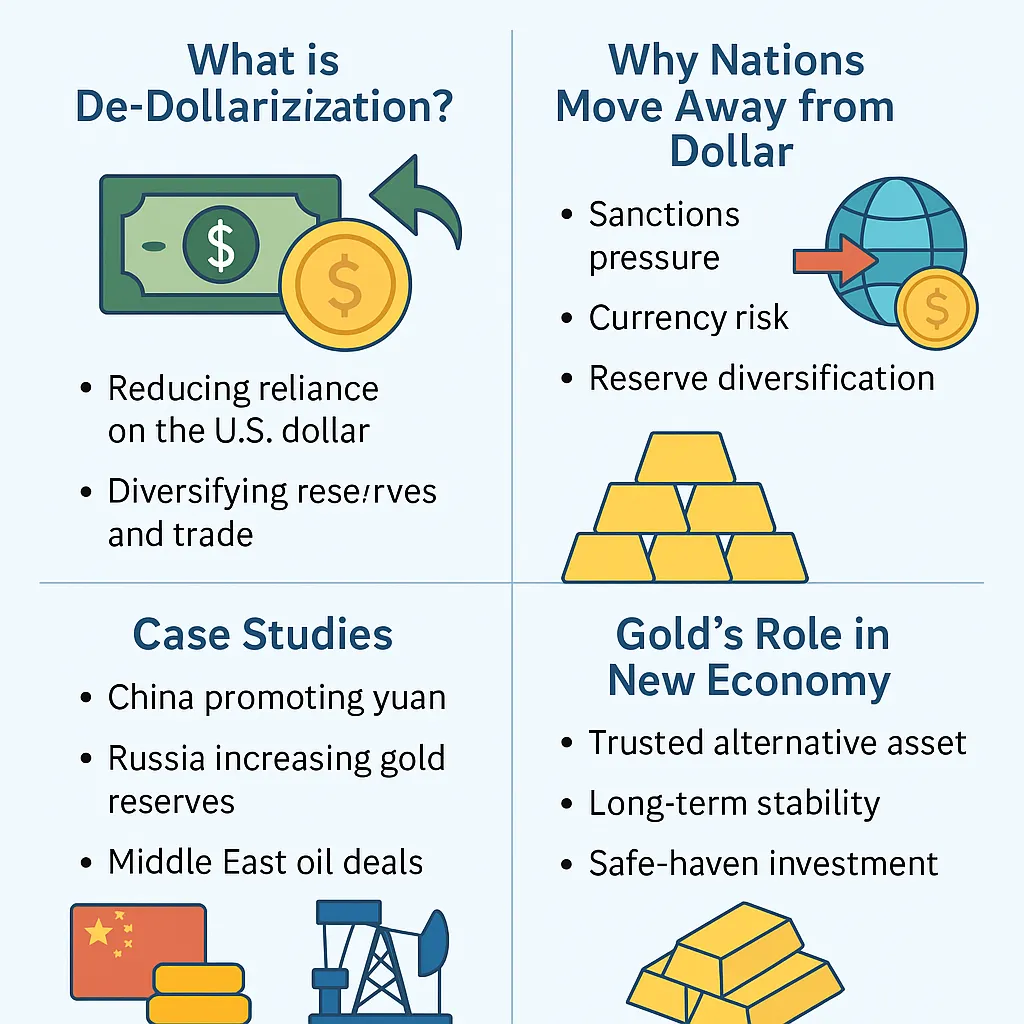
What is De-Dollarization?
De-dollarization refers to the process of reducing reliance on the U.S. dollar for reserves, trade, and international transactions. Instead, countries are diversifying into:
-
Gold reserves
-
Regional currencies (like yuan, euro)
-
Bilateral trade agreements
Why Countries Are Moving Away from the Dollar
-
Sanctions Pressure: U.S. sanctions on nations like Russia and Iran made them explore alternatives.
-
Currency Risk: Dollar volatility threatens economic stability.
-
Reserve Diversification: Gold provides a hedge against political and financial shocks.
-
Geopolitical Strategy: Emerging powers seek to reduce U.S. dominance in global finance.
Case Studies – De-Dollarization in Action
-
Russia: Increased gold holdings significantly after facing Western sanctions.
-
China: Promoting yuan in global trade while boosting gold reserves.
-
Middle East: Some oil deals are now settled outside of the dollar system.
Implications for Gold Reserves
-
Rising Demand: Central banks are adding more gold to diversify.
-
Price Support: Sustained buying creates long-term stability for gold.
-
Safe-Haven Asset: In crises, gold maintains trust compared to fiat currencies.
Risks and Challenges
-
Gold provides stability but does not generate yield.
-
Rapid de-dollarization may create short-term financial uncertainty.
-
Global coordination is difficult; dollar remains dominant in many sectors.
In 2023, China and Russia settled a major energy trade deal without using U.S. dollars. Both nations increased their gold reserves in the same period, showing how de-dollarization and gold accumulation go hand in hand.
Student Section
Summary:
De-dollarization is pushing countries to reduce dollar dependence and increase gold reserves. This strengthens gold’s role in global finance but also poses new challenges.
Quiz:
-
What does de-dollarization mean?
-
Why is gold preferred during de-dollarization?
-
Which two countries are leading this trend?
-
What is one risk of relying too heavily on gold?
Difficult Words Table:
| Word | Meaning in Urdu |
|---|---|
| De-dollarization | ڈالر پر انحصار کم کرنا |
| Sanctions | پابندیاں |
| Hedge | رسک سے بچاؤ |
| Dominance | غلبہ / برتری |
FAQs
Q1: What is de-dollarization?
It is the process of reducing reliance on the U.S. dollar for trade and reserves.
Q2: Why does de-dollarization increase gold demand?
Because gold is trusted globally and provides stability without political risk.
Q3: Will gold replace the dollar completely?
Not entirely, but it will play a stronger role in reserve diversification.
Q4: Which regions are most active in de-dollarization?
Asia, Middle East, and some Latin American countries.