
Introduction
Whenever the world enters a financial storm, one metal becomes the center of attention: gold. From the 1970s stagflation crisis to the 2008 global meltdown and even the COVID-19 pandemic in 2020, gold has served as a safe haven for investors.
During crises, stock markets tumble, currencies weaken, and investor confidence falls. Yet, gold often maintains or increases its value. This timeless role of gold makes it essential to study how it reacts during global financial crises and what its future outlook might be in a world full of uncertainty.
Gold in Past Financial Crises
The 1970s Stagflation
In the 1970s, rising inflation combined with slow growth created a perfect storm. While paper assets lost real value, gold prices surged, proving its resilience.
The 2008 Global Financial Crisis
During the banking collapse of 2008, investors rushed to gold. Prices climbed nearly 25% in just two years, showing gold’s role as a hedge against systemic risk.
The 2020 Pandemic Shock
As global markets crashed in early 2020, gold crossed $2,000 per ounce for the first time, cementing its position as a safe haven during extreme uncertainty.
Why Gold is a Safe Haven
-
Limited supply: Unlike paper money, it cannot be printed endlessly.
-
Universal value: Trusted across cultures and borders.
-
Hedge against inflation: Protects purchasing power when currencies weaken.
Risks & Limitations of Gold in Crises
-
Gold can be volatile in short-term liquidity crunches.
-
It pays no dividend or interest.
-
In some crises (like 2008 Q1), gold initially fell as investors sold everything for cash.
Future Outlook of Gold in Crises
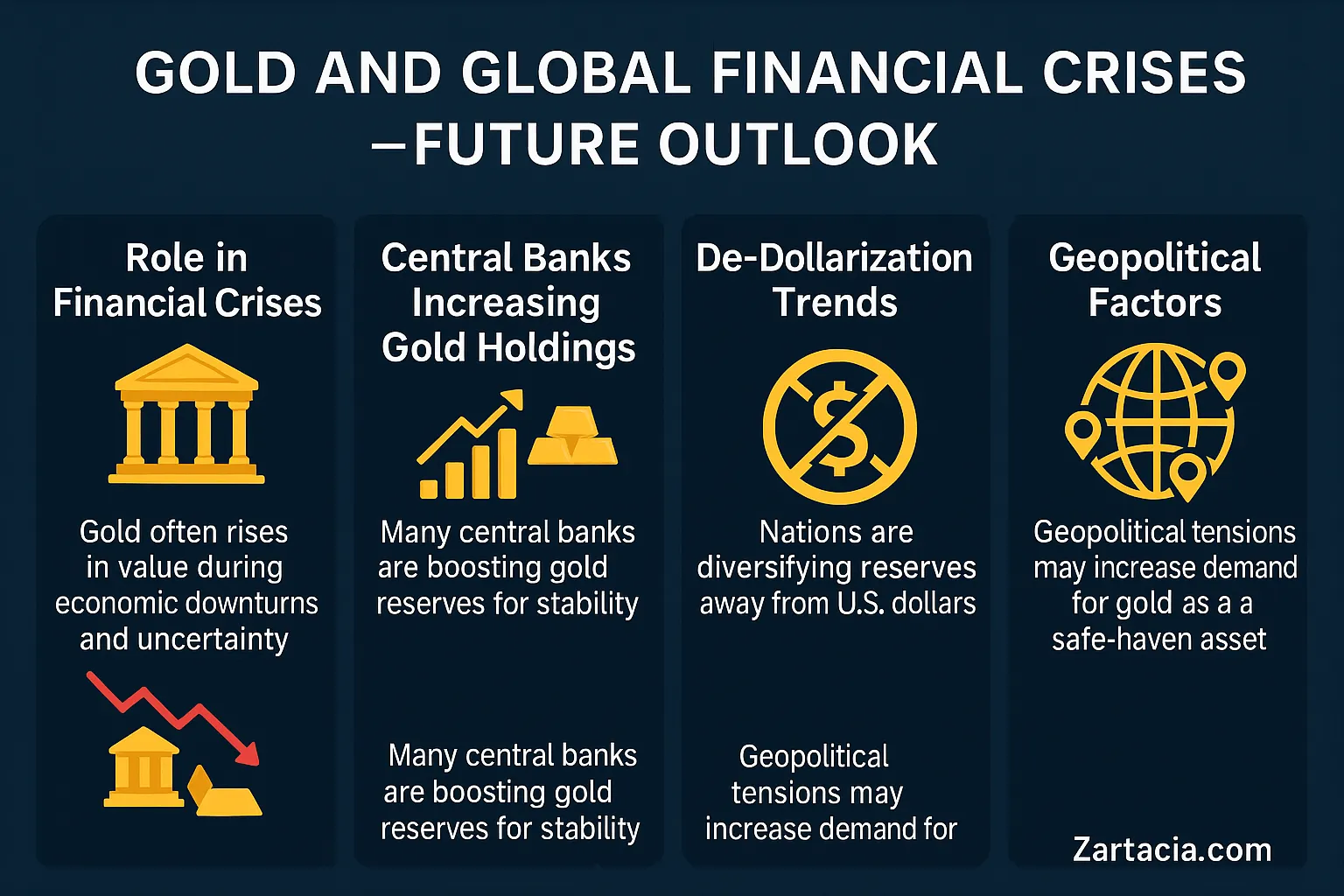
Economists predict that gold will remain a hedge against:
-
Sovereign debt defaults
-
Currency devaluation
-
Geopolitical tensions
-
Inflation and de-dollarization
In the next decade, central bank buying and investor demand may push gold even higher whenever new crises unfold.
In 2008, Ali invested part of his savings in gold while his friend Sara kept her money in stocks. Within a year, Sara’s portfolio had lost 40%, while Ali’s gold investment had grown steadily. This simple example shows why gold is considered a safe-haven asset during crises.
Student Section
Summary:
Gold consistently proves its worth during global financial crises. From 1970s inflation to 2008 and 2020, gold has acted as a hedge and safe haven. The future outlook suggests gold will continue to shine during economic uncertainty.
Quiz:
-
What happened to gold prices during the 1970s stagflation?
-
Why did investors rush to gold in 2008?
-
What record price did gold cross during the 2020 pandemic?
-
Name one limitation of investing in gold.
Difficult Words Table:
| Word | Meaning in Urdu |
|---|---|
| Stagflation | معاشی جمود کے ساتھ مہنگائی |
| Hedge | رسک سے بچاؤ |
| Volatile | غیر مستحکم، اتار چڑھاؤ |
| Devaluation | کرنسی کی قدر میں کمی |
FAQs
Q1: Why is gold called a safe haven?
Because it protects value during economic crises when other assets fall.
Q2: Does gold always rise in every crisis?
Not immediately. Sometimes it falls first, but long-term it usually gains.
Q3: Is gold better than stocks during crises?
It depends. Stocks can recover faster, but gold offers stability.
Q4: What role do central banks play in gold demand?
They buy gold to strengthen reserves and reduce reliance on the US dollar.
Read More Section
People are also reading:
-
The Gold Standard – Adoption, Decline, End
-
Modern Gold Reserves – Banks, IMF, Governments
