

Introduction to Gold (Au): Properties, Discovery & Global Importance
Gold, symbol Au, with an atomic number of 79, is one of the most fascinating metals in the history of humankind. From the earliest days of civilization, gold has attracted people due to its beauty, rarity, and durability. Kings built their empires with it, traders measured their wealth by it, and today investors use it as a safe haven against inflation and economic crisis.
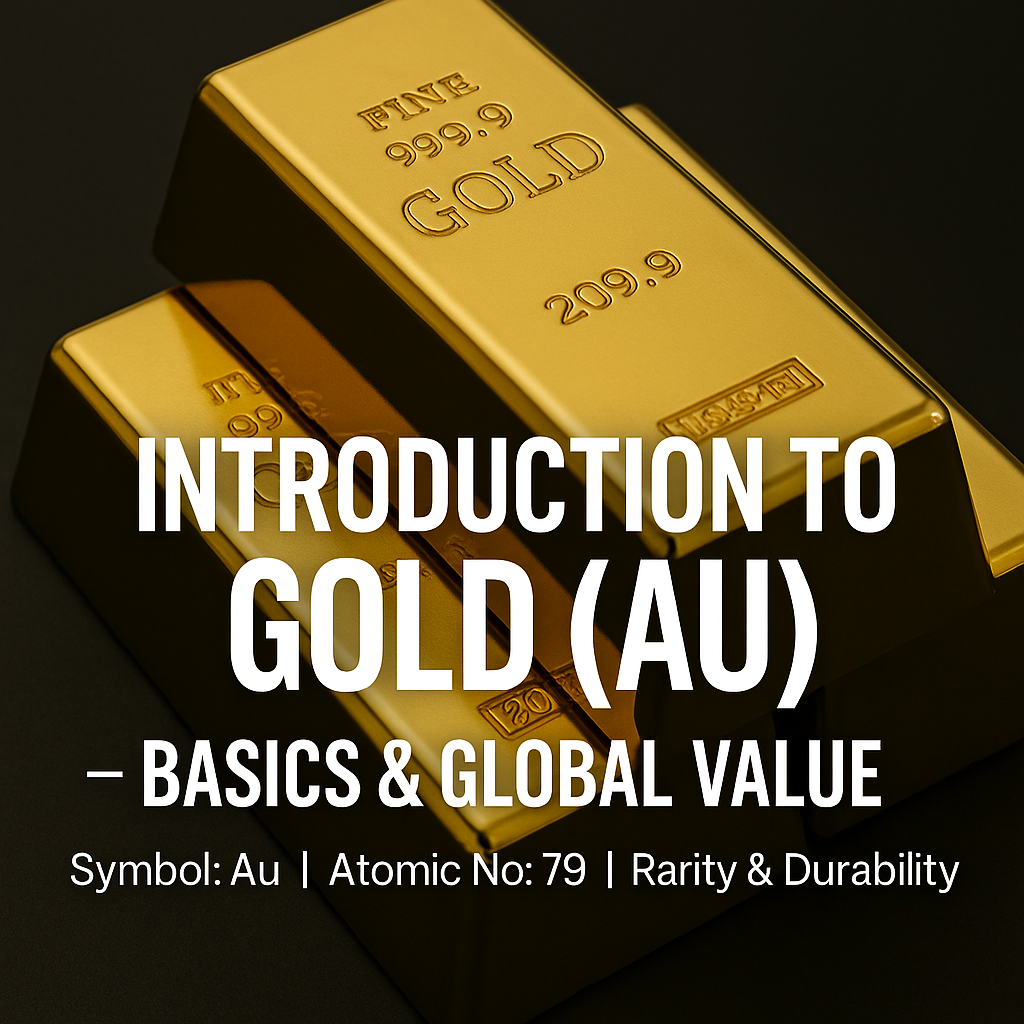
This article serves as a beginner’s guide to understanding gold, covering its scientific properties, early discovery, and global value. Whether you are a student, an investor, or simply a curious learner, this post will help you appreciate why gold continues to shine as one of the most powerful assets on Earth.
Definition of Gold
Gold is a chemical element with the symbol Au, derived from the Latin word Aurum, meaning “shining dawn.” It belongs to the category of transition metals and is famous for its bright yellow luster.
Basic Characteristics of Gold
- Atomic Number: 79
- Atomic Weight: 196.967 g/mol
- Density: 19.32 g/cm³ (very dense compared to most metals)
- Malleability: Gold is the most malleable metal, meaning it can be beaten into extremely thin sheets.
- Ductility: A single gram of gold can be drawn into a thread over 2 kilometers long.
- Conductivity: Excellent conductor of heat and electricity, making it useful in technology.
- Non-reactive: Unlike iron or copper, gold does not rust, tarnish, or corrode.
👉 These properties explain why gold has always been considered unique and precious compared to other metals.
Discovery of Gold
Gold is one of the first metals discovered by humans, thousands of years before the modern periodic table was even imagined.
- Earliest Mining: Evidence shows that ancient Egyptians mined gold as early as 4000 BC. They used it for ornaments, idols, and temples.
- Cultural Value: Archeologists have found gold jewelry in royal tombs, proving that it was associated with power and immortality.
- Coins and Currency: The first gold coins appeared in Lydia (modern-day Turkey) around 600 BC, marking gold’s entry into global trade.
- Symbol of Authority: From Pharaohs in Egypt to Emperors in Rome, rulers used gold to display wealth and divine power.
Gold was not discovered in the same way as new elements in laboratories—it was always present, shining in rivers, rocks, and soil. Humanity’s relationship with gold is therefore ancient, natural, and timeless.
Why Gold is Valued Globally?
Gold’s value is not accidental; it is the result of rare natural qualities and universal acceptance.
Key Reasons for Global Value
- Rarity – Gold is limited in nature and difficult to mine. For every ton of rock, only a few grams of gold may be extracted.
- Durability – It does not rust, tarnish, or lose shine, making it eternal. A gold artifact made thousands of years ago still shines today.
- Symbolism – Gold represents wealth, purity, and prestige across almost every culture and religion.
- Universality – Unlike other metals, gold has been accepted worldwide as a store of value, currency, and ornament.
Gold in Human Civilization
Gold’s importance goes beyond science; it has shaped cultures, economies, and societies.
- In Egypt, gold was believed to be the “flesh of the gods.”
- In Rome, soldiers were sometimes paid in gold coins.
- In the Islamic era, gold was used for the Dinar, a standard currency in trade.
- In the Indian subcontinent, gold became a symbol of prosperity, used in weddings, dowries, and royal treasuries.
Even in modern times, when we have paper money and digital currencies, gold still acts as a safe investment during economic crises.
Scientific Importance of Gold
Apart from jewelry and currency, gold has a crucial role in science and technology:
- Used in electronics (mobiles, laptops, space equipment) due to high conductivity.
- Used in medicine (dentistry, cancer treatments, implants).
- Used in aerospace (satellites, spacecrafts).
This dual role—ornamental and scientific—makes gold indispensable in the modern world.
Gold as a Safe Haven Asset
During wars, pandemics, or financial crashes, investors turn to gold. This is because:
- Gold maintains its value even when currencies lose purchasing power.
- It acts as a hedge against inflation.
- Central banks keep gold reserves to strengthen economic stability.
👉 For this reason, many people see gold as a trustworthy friend in uncertain times.
Conclusion
Gold is more than just a metal; it is a symbol of wealth, stability, and culture. From its atomic properties to its role in civilizations, it continues to hold global importance. Whether you look at it scientifically, historically, or economically, gold shines equally bright.
This was just the beginning of our journey. In the next article, we will explore the History of Gold—from Ancient Egypt to the modern world.
FAQs
Q1. What is the chemical symbol of Gold?
The symbol is Au, derived from the Latin Aurum.
Q2. When was gold first mined?
Gold mining dates back to 4000 BC in ancient Egypt and Mesopotamia.
Q3. Why does gold not rust?
Because it is a non-reactive metal that does not combine easily with oxygen or moisture.
Q4. Why is gold still important in modern times?
It is a safe investment, used in technology, and valued universally as wealth.
Q5. What makes gold different from silver or copper?
Gold does not tarnish, is rarer, and has been universally accepted as a store of value.
🟢 Internal Linking Suggestions
- Link to “History of Gold – From Egypt to Modern Era” (Part II)
- Link to “Gold as Currency and Economy” (Part III)
🟢 External Linking Suggestions
- World Gold Council
- https://www.imf.org/IMF – Gold Reserves
article no 01