

Keyword Research – Step by Step Guide
Every successful SEO strategy starts with keyword research. If you don’t know what people are searching for, your content will never reach the right audience. Keyword research helps identify the exact terms users type into Google, giving you insight into their needs, questions, and buying intent.
In 2025, keyword research is more advanced but also more important than ever. With voice search, AI-driven results, and mobile-first browsing, businesses must choose keywords carefully to stand out. This guide walks you through keyword research step by step, showing how to find profitable terms that attract the right audience.
By the end of this article, you’ll know how to uncover keywords, analyze competition, and use them strategically for long-term SEO success.
What is Keyword Research?
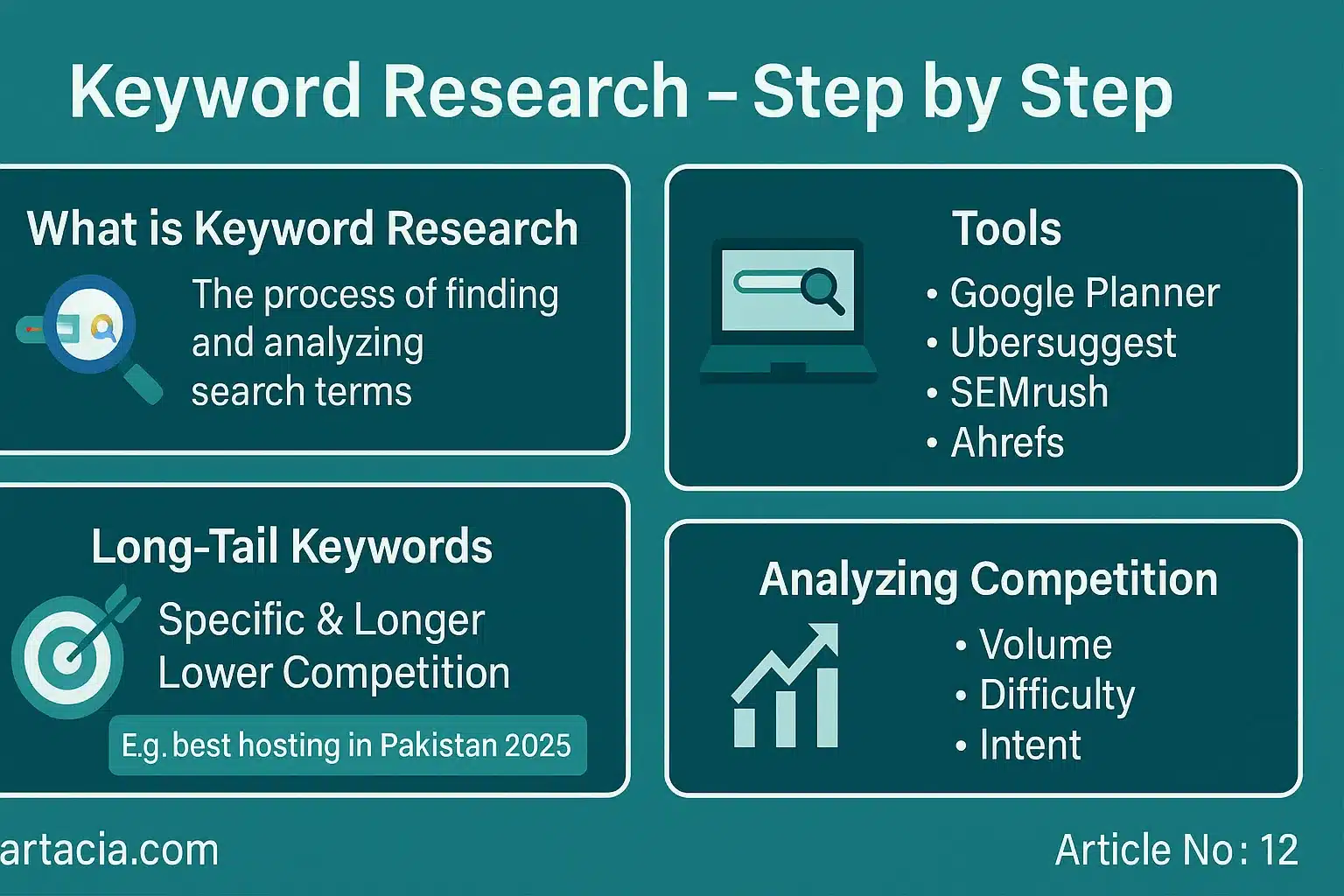
Keyword research is the process of discovering and analyzing search terms that people enter into search engines. It helps you understand what your target audience wants and ensures your content matches their intent.
Benefits include:
-
Driving relevant traffic to your website
-
Understanding user needs and trends
-
Creating content that ranks and converts
Example: Instead of targeting “shoes,” a local business may find “affordable running shoes in Karachi” is more relevant and less competitive.
Tools for Keyword Research
There are many free and paid tools to simplify keyword research.
-
Google Keyword Planner → Great for beginners, free with Google Ads account.
-
Ubersuggest → Affordable tool for keyword ideas and SEO metrics.
-
SEMrush / Ahrefs → Advanced tools for competitive analysis.
-
AnswerThePublic → Shows real user questions for content ideas.
-
Google Search / Autocomplete → Free insights from search suggestions.
Case Study: A freelancer used Ubersuggest to find long-tail keywords like “best freelancing sites for beginners in Pakistan” and ranked within months.
Finding Long-Tail Keywords
Long-tail keywords are longer, more specific search phrases. They have lower competition and higher conversion rates.
Example:
-
Short keyword: Hosting (too broad)
-
Long-tail keyword: Best affordable hosting in Pakistan 2025
Steps to find long-tail keywords:
-
Use tools like AnswerThePublic or Google autocomplete.
-
Check related searches at the bottom of Google results.
-
Analyze competitors’ blogs for keyword ideas.
Analyzing Competition
Not all keywords are worth targeting. Before choosing, analyze competition:
-
Search Volume → Is there enough demand?
-
Keyword Difficulty (KD) → Is it possible to rank with your site’s authority?
-
Top Results Analysis → What type of content ranks? (blogs, videos, e-commerce)
Tip: Focus on keywords with medium search volume and low difficulty—they provide the best balance.
Student Section
✅ Summary (150 words)
Keyword research is the foundation of SEO and ensures you create content people are actively searching for. In 2025, effective keyword research involves identifying relevant terms, analyzing competition, and targeting long-tail keywords that offer high conversions. Tools like Google Keyword Planner, Ubersuggest, SEMrush, and AnswerThePublic help uncover opportunities. Beginners should focus on long-tail keywords such as “best hosting in Pakistan 2025” instead of generic terms like “hosting.” Competition analysis is also crucial—keywords with high search volume may be too competitive, while low-difficulty terms are easier to rank for. The best strategy is to balance volume, difficulty, and user intent. By applying this step-by-step approach, businesses and bloggers can improve visibility, attract relevant traffic, and generate sustainable results.
📝 Quiz
-
What is keyword research?
Answer: The process of finding and analyzing search terms people use online. -
Name one free keyword research tool.
Answer: Google Keyword Planner. -
What are long-tail keywords?
Answer: Specific, longer keyword phrases with less competition. -
Why is competition analysis important?
Answer: To choose keywords you can realistically rank for. -
Which is better for beginners: short or long-tail keywords?
Answer: Long-tail keywords.
📘 Difficult Words Table
| Word | Meaning in Urdu |
|---|---|
| Conversion | وزیٹر کو خریدار میں بدلنا |
| Autocomplete | خودکار تکمیل |
| Authority | اختیار / وقار |
| Relevant | متعلقہ / موزوں |
| Sustainable | پائیدار / دیرپا |
FAQs
Q1: How often should I do keyword research?
At least once every 3–6 months to keep up with trends.
Q2: Can I rely only on free tools?
Yes, but paid tools like Ahrefs give deeper insights.
Q3: Are long-tail keywords always better?
Not always, but they are usually easier to rank for.
Q4: Do keywords still matter with AI search results?
Yes, keywords remain important but must align with user intent.
📖 People are also reading
-
“Long-Tail Keywords – Why They Matter”
-
“Content Length vs Quality – What Google Prefers”
-
“On-Page SEO Checklist for Beginners”
