
Introduction
Modern software development is not just about writing code—it’s about delivering updates quickly, safely, and consistently. This is where DevOps and CI/CD (Continuous Integration / Continuous Deployment) come into play.
DevOps is a culture that combines development and operations teams, while CI/CD pipelines automate building, testing, and deploying applications. With CI/CD, every code update can be tested and released in minutes instead of weeks.
In this class, we will explore the fundamentals of DevOps, the stages of CI/CD, and the popular tools used for automation.
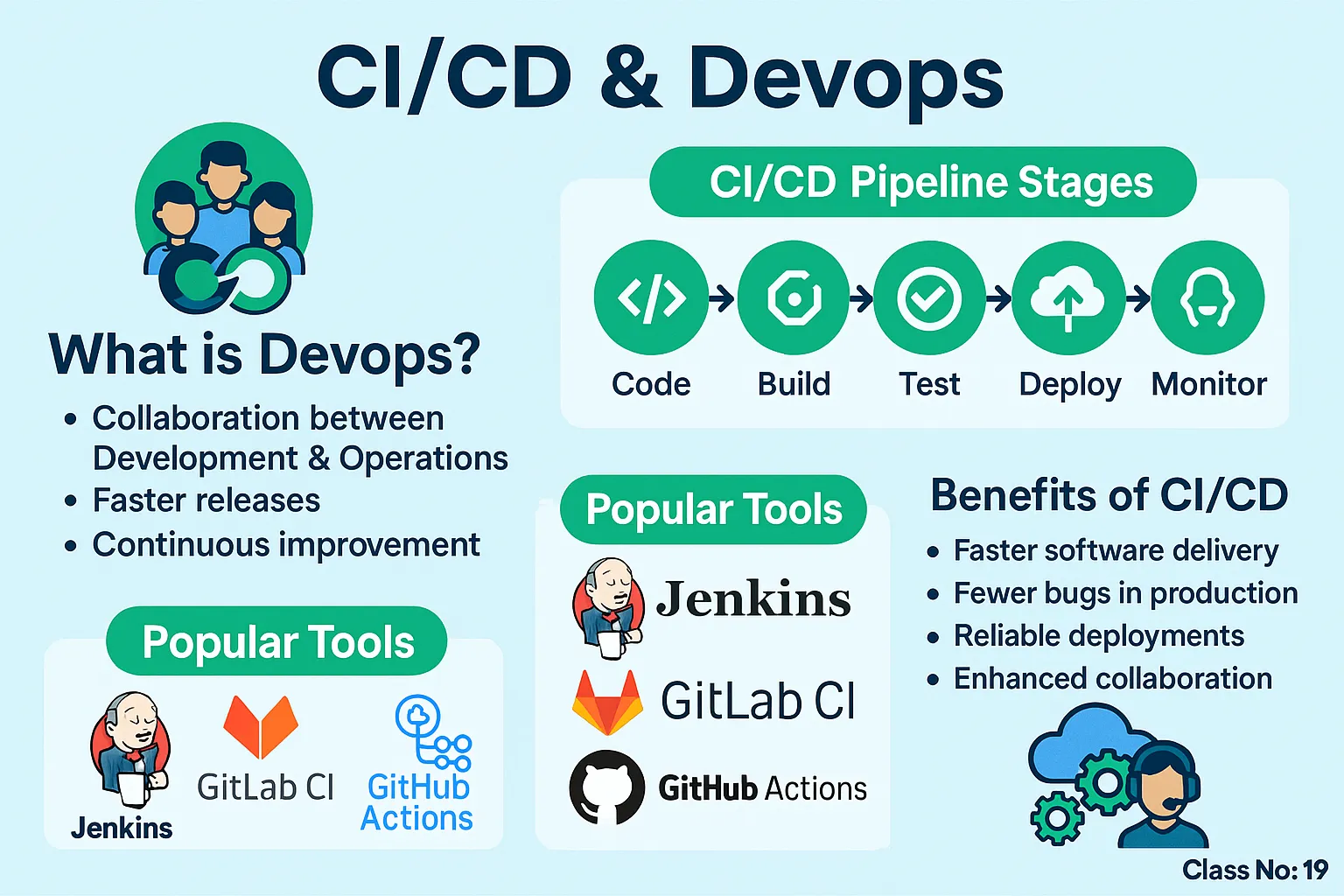
What is DevOps?
-
Definition: A collaboration between developers and operations teams to improve software delivery.
-
Goal: Faster releases, fewer errors, and continuous improvement.
-
Principles:
-
Collaboration & communication
-
Automation everywhere
-
Monitoring & feedback loops
-
Example: Instead of waiting for monthly releases, a DevOps team can release updates daily.
CI/CD Basics
-
Continuous Integration (CI):
Developers push code to a shared repository (Git). Automated tests run to ensure no errors. -
Continuous Deployment (CD):
After tests pass, code is automatically deployed to production.
Pipeline Stages:
-
Code → Build → Test → Deploy → Monitor
Popular CI/CD Tools
-
Jenkins: Open-source automation server.
-
GitLab CI/CD: Built into GitLab, easy integration with repos.
-
GitHub Actions: Automation for GitHub repositories.
-
CircleCI & TravisCI: Cloud-based CI/CD platforms.
Example: Using GitHub Actions to automatically deploy a website every time code is pushed.
Benefits of CI/CD & DevOps
-
Faster software delivery
-
Fewer bugs in production
-
Reliable deployments
-
Enhanced collaboration between teams
-
Scalability with cloud-native apps
Case Study: Netflix uses DevOps practices to release thousands of changes per day.
Practical Task
-
Create a GitHub repository.
-
Add a simple CI/CD pipeline with GitHub Actions.
-
Deploy a small web app to a cloud server automatically.
Student Section
Summary (150 words):
CI/CD and DevOps revolutionize software delivery by combining automation with teamwork. Continuous Integration ensures that every code update is tested automatically, while Continuous Deployment delivers changes directly to production. DevOps culture emphasizes collaboration, monitoring, and automation. Tools like Jenkins, GitLab CI, and GitHub Actions make pipelines simple and effective. The benefits include faster releases, fewer bugs, and more efficient teamwork. For server administrators, learning CI/CD ensures they can manage automated deployments and contribute to modern DevOps teams.
Quiz:
-
What does DevOps stand for?
-
What is the difference between CI and CD?
-
Name one CI/CD tool.
-
What is the main goal of DevOps?
-
What does a pipeline do?
Difficult Words Table:
| Word | Meaning in Urdu |
|---|---|
| Integration | انضمام / ملاپ |
| Deployment | اطلاق / نفاذ |
| Collaboration | تعاون / شراکت داری |
| Pipeline | عمل کی ترتیب وار لڑی |
| Automation | خودکار عمل |
FAQs
Q1: Is DevOps a tool?
No, it’s a culture and methodology, supported by tools.
Q2: Can small projects use CI/CD?
Yes, CI/CD works for both small and enterprise projects.
Q3: Which CI/CD tool is best for beginners?
GitHub Actions is simplest for beginners.
Q4: Does CI/CD eliminate testing?
No, it automates and strengthens testing.
Q5: Is Jenkins free?
Yes, Jenkins is free and open-source.
Read More (Internal Links in Urdu)
-
یہ بھی پڑھیں: Server Automation with Scripts and Tools
-
یہ بھی پڑھیں: Cloud Hosting Hands-on
-
یہ بھی پڑھیں: Server Performance Optimization