

Introduction
As websites grow, a single server is no longer enough to handle heavy traffic. Scaling ensures that resources expand to meet demand, while high availability (HA) guarantees that services stay online even if one server fails.
From clustering databases to using CDNs, scaling and HA are the foundation of reliable large-scale hosting. In this class, we will explore techniques and tools to achieve both.
What is Scaling?
Scaling means increasing resources to handle more traffic.
Types of Scaling:
-
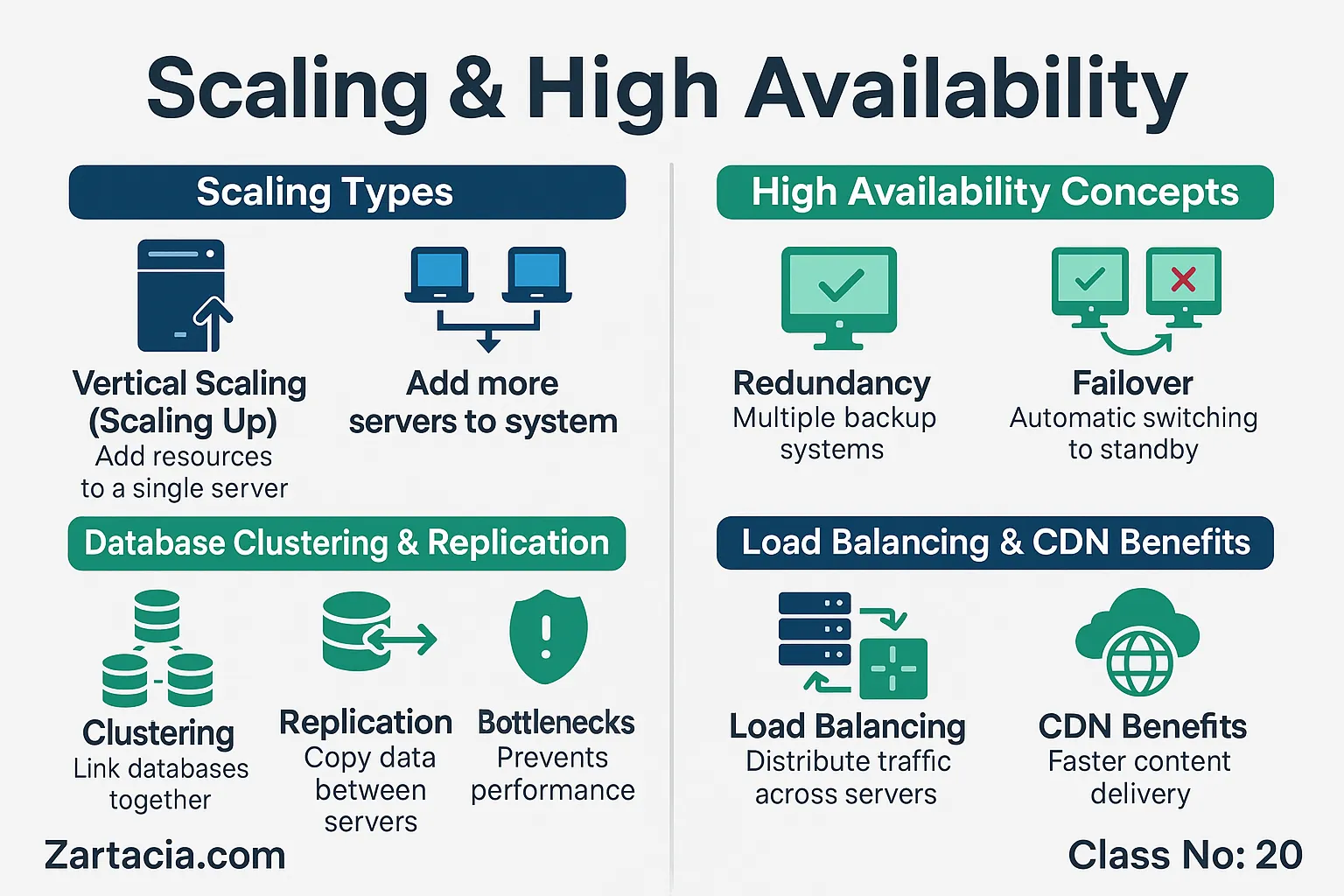
Vertical Scaling (Scaling Up): Add more CPU, RAM, or storage to one server.
-
Horizontal Scaling (Scaling Out): Add more servers to distribute load.
Example: An e-commerce website doubles its traffic on Black Friday. Scaling ensures no downtime.
High Availability (HA) Concepts
High availability ensures services remain accessible despite failures.
Techniques:
-
Redundancy: Multiple servers for backup.
-
Failover Systems: Automatic switch to standby server.
-
Load Balancing: Spreads traffic across multiple servers.
Goal: 99.9% or higher uptime.
Clustering & Database Replication
Databases are often the bottleneck in scaling. Clustering solves this by linking multiple databases.
-
MySQL Replication: Master → Slave setup for backups.
-
Redis Cluster: Distributes cache across nodes.
-
MongoDB Replica Sets: Ensure no single point of failure.
Example: Facebook uses replication to handle billions of queries daily.
Load Balancing
Load balancers distribute traffic evenly.
Popular Tools:
-
HAProxy
-
NGINX Load Balancer
-
AWS Elastic Load Balancing (ELB)
Benefits:
-
No single server overload
-
Improved response times
-
Better fault tolerance
CDN Integration
A Content Delivery Network (CDN) caches static files on global servers.
Benefits:
-
Faster page loads
-
Reduced server load
-
Protection from DDoS attacks
Examples: Cloudflare, Akamai, AWS CloudFront.
Practical Task
-
Configure an NGINX load balancer with two web servers.
-
Set up MySQL master-slave replication.
-
Enable Cloudflare CDN for your website.
Student Section
Summary (150 words):
Scaling and high availability ensure websites handle traffic spikes and remain online during failures. Scaling can be vertical (adding resources) or horizontal (adding servers). High availability uses redundancy, failover, and load balancing to guarantee uptime. Clustering databases and replicating data prevent bottlenecks, while CDNs deliver content globally at high speed. Together, these strategies form the backbone of enterprise-grade hosting. Without scaling and HA, websites risk downtime, lost revenue, and poor user experience.
Quiz:
-
What is the difference between vertical and horizontal scaling?
-
What does high availability mean?
-
Name one database replication method.
-
What tool is used for load balancing?
-
Why use a CDN?
Difficult Words Table:
| Word | Meaning in Urdu |
|---|---|
| Redundancy | زائد بیک اپ / اضافی نظام |
| Failover | متبادل نظام پر خودکار منتقلی |
| Replication | نقل بنانا / کاپی کرنا |
| Bottleneck | رکاوٹ / سست روی کا سبب |
| Tolerance | برداشت / نظامی مزاحمت |
FAQs
Q1: Is scaling always expensive?
Not necessarily; cloud platforms allow cost-efficient scaling.
Q2: What is the difference between scaling and high availability?
Scaling handles more load, HA ensures uptime during failures.
Q3: Do small websites need clustering?
No, clustering is for medium-to-large-scale applications.
Q4: Can CDNs replace web servers?
No, CDNs only cache static content; servers are still needed.
Q5: How much uptime is considered high availability?
At least 99.9% uptime.
Read More (Internal Links in Urdu)
-
یہ بھی پڑھیں: Server Performance Optimization
-
یہ بھی پڑھیں: Virtualization and Cloud Hosting
-
یہ بھی پڑھیں: Backup and Disaster Recovery