
🌟 Introduction
Gold has always attracted human desire, but Islam places great emphasis on ethical use of wealth. Hoarding gold without paying Zakat or using it productively is discouraged, while circulating it through trade, charity, and investment is highly recommended. This article explores the Islamic perspective on hoarding vs circulation, highlighting Qur’anic verses, Hadith, and modern implications.
Qur’an on Hoarding Gold
The Qur’an explicitly condemns hoarding wealth without spending it in the way of Allah:
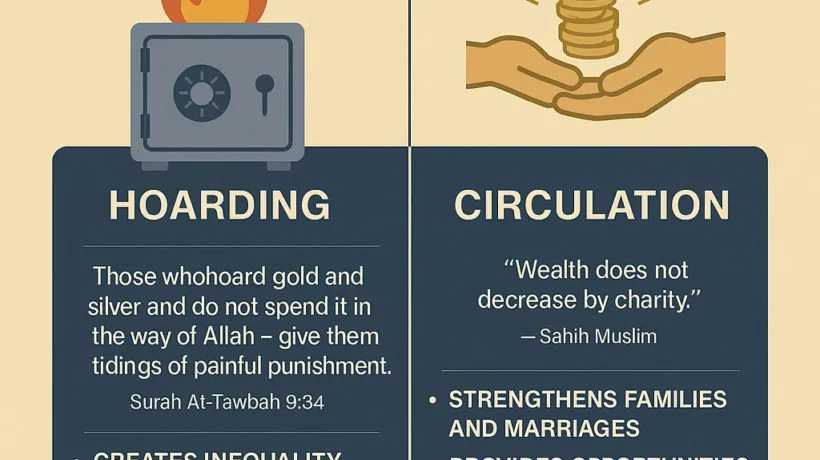
“Those who hoard gold and silver and do not spend it in the way of Allah – give them tidings of a painful punishment.” (Surah Al-Tawbah 9:34)
This verse warns against selfish accumulation that benefits neither the owner nor society. In contrast, wealth should circulate to strengthen families, communities, and economies.
Hadith on Circulation of Wealth
Prophet Muhammad ﷺ said:
“Wealth does not decrease by charity.” (Muslim)
This shows that circulation of wealth, including gold, results in barakah (blessing). Islam promotes the use of gold in trade, dowries, and charity so that wealth supports social justice and economic growth.
Ethical Comparison – Hoarding vs Circulation
Hoarding
-
Creates inequality.
-
Leads to arrogance and greed.
-
Blocks resources from reaching the needy.
Circulation
-
Strengthens families and marriages.
-
Provides opportunities for trade and business.
-
Brings social balance and justice.
Modern Application
In today’s time, hoarding gold in lockers without paying Zakat can harm society by locking resources. On the other hand, using gold for Islamic finance, ethical investment, or helping the poor ensures wealth benefits many people.

📚 Student Section
🔹 Summary
-
Islam discourages hoarding gold.
-
Qur’an and Hadith emphasize circulation of wealth.
-
Ethical use of gold = justice + balance.
-
Hoarding = selfishness, Circulation = barakah.
🔹 Quiz
-
Which Qur’anic verse warns against hoarding gold?
-
What does Hadith say about wealth decreasing by charity?
-
Name two harms of hoarding gold.
-
How does circulation benefit society?
-
What is the modern way of using gold ethically?
🔹 Difficult Words with Urdu Meanings
| Word | Meaning (Urdu) |
|---|---|
| Hoarding | ذخیرہ اندوزی – جمع کر لینا |
| Circulation | گردش – لین دین |
| Inequality | ناہمواری – عدم مساوات |
| Justice | انصاف – عدل |
| Arrogance | غرور – تکبر |
❓ FAQs
Q1: Is hoarding gold haram?
Ans: Hoarding without paying Zakat or using wealth beneficially is strongly condemned in Islam.
Q2: Why is circulation of wealth important?
Ans: It ensures fairness, supports families, and reduces poverty.
Q3: How can gold be circulated today?
Ans: Through Zakat, Islamic finance, trade, and ethical investments.
Q4: What is the spiritual harm of hoarding?
Ans: It creates arrogance, greed, and neglect of social responsibility.
Q5: Does charity reduce wealth?
Ans: No, Hadith confirms it brings blessings instead.
🔗 Internal Linking Suggestions
-
Link to Article 21: Zakat on Gold – Nisab and Calculation
-
Link to upcoming Article 23: Gold in the Qur’an – Verses and Lessons
-
Link to Article 9: Religious and Jurisprudential Aspects of Gold
🔗 External Linking Suggestions
🌟 Conclusion
Islam’s message on gold is clear: do not hoard, circulate instead. Hoarding creates greed and inequality, while circulation ensures justice, blessings, and social balance. By choosing circulation, Muslims transform gold into a source of barakah and unity.