

Introduction
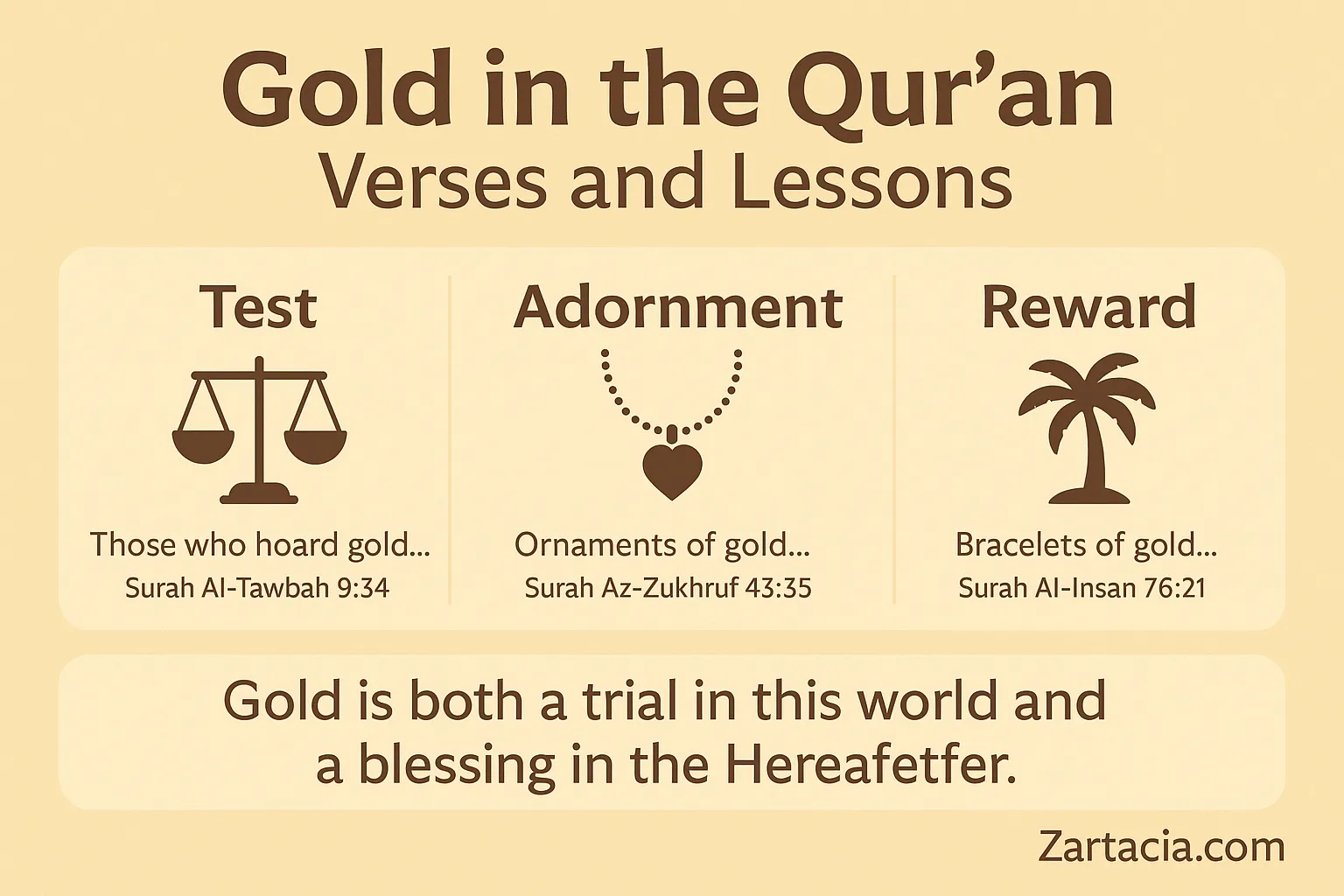
Gold holds a special place in human history, but the Qur’an gives it deeper meaning. It is mentioned both as a test in this world and a reward in the Hereafter. By reflecting on these verses, Muslims learn how to balance between the love of wealth and the responsibility of sharing it.
Test of Wealth
The Qur’an warns against hoarding gold and silver without spending it in the way of Allah:
“Those who hoard gold and silver and do not spend it in the way of Allah – give them tidings of a painful punishment.” (Surah Al-Tawbah 9:34)
This verse highlights that wealth, when misused, becomes a burden rather than a blessing. Islam teaches that gold should circulate through Zakat, trade, and charity rather than lying idle.
Adornment of Worldly Life
Another Qur’anic verse points to the attraction of gold as part of worldly decoration:
“…and ornaments of gold. Yet all this is but enjoyment of the worldly life. The Hereafter with your Lord is better and lasting.” (Surah Al-Zukhruf 43:35)
This shows that while gold can be enjoyed, believers must remember that its true value lies only when used ethically and not as a symbol of pride.
in Paradise – Reward for the Righteous
The Qur’an also describes gold as a reward in Jannah:
“They will be adorned with bracelets of gold and will wear green garments of fine silk and brocade.” (Surah Al-Insan 76:21)
Here, gold is shown not as a test but as a heavenly honor for those who live righteous lives. This gives Muslims hope and motivation to use wealth responsibly in this world.
Lessons for Today
In today’s society, gold is often treated only as an asset. But Qur’anic teachings remind us that it is:
-
A test when hoarded.
-
A decoration when used in moderation.
-
A reward in the Hereafter for the faithful.
Therefore, Muslims should use gold wisely—balancing between worldly needs and spiritual responsibilities.
📚 Student Section
🔹 Summary
-
Qur’an mentions gold as a test, adornment, and reward.
-
Hoarding without Zakat leads to punishment.
-
Gold in Paradise symbolizes eternal success.
-
Ethical usage is key to balancing dunya and akhirah.
🔹 Quiz
-
Which Surah warns about hoarding gold and silver?
-
What does Surah Al-Zukhruf say about gold?
-
In which Surah is gold mentioned as a reward in Paradise?
-
What are the three Qur’anic dimensions of gold?
-
Why is moderation important in using gold?
🔹 Difficult Words with Urdu Meanings
| Word | Meaning (Urdu) |
|---|---|
| Hoard | ذخیرہ – جمع کرنا |
| Adornment | زینت – آرائش |
| Paradise | جنت – آخرت کی نعمتیں |
| Punishment | سزا – عذاب |
| Moderation | اعتدال – درمیانی راستہ |
❓ FAQs
Q1: How many times is gold mentioned in the Qur’an?
Ans: Gold is mentioned multiple times in contexts of wealth, punishment, and Paradise.
Q2: Is gold considered haram in Islam?
Ans: No, but misuse such as hoarding without Zakat is condemned.
Q3: Why does Qur’an mention gold as adornment?
Ans: To remind believers that worldly beauty is temporary.
Q4: What is the spiritual meaning of gold in Paradise?
Ans: It represents eternal honor and blessings for the righteous.
Q5: How should Muslims treat gold today?
Ans: As a trust—use ethically, pay Zakat, avoid arrogance.
🔗 Internal Linking Suggestions
-
Link to Article 21: Zakat on Gold – Calculation and Nisab
-
Link to Article 22: Hoarding vs Circulation in Islam
-
Link to Article 9: Religious Aspects of Gold
🔗 External Linking Suggestions
🌟 Conclusion
The Qur’an presents gold not just as a metal but as a spiritual lesson. It tests the greedy, decorates the world, and rewards the faithful in Paradise. By following these lessons, Muslims can transform gold from a symbol of pride into a path toward eternal success.
