
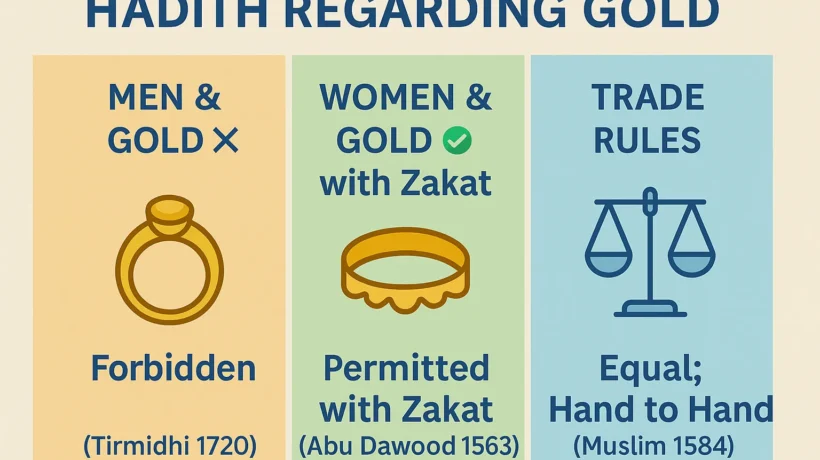
Hadith Regarding Gold – Rules and Teachings
Gold is not only a symbol of wealth but also a matter of guidance in Islamic teachings. The Prophet Muhammad ﷺ spoke about gold in detail—whether in the context of jewelry, transactions, or charity. These Hadith provide clear rules for Muslims and highlight the importance of balance between enjoying wealth and fulfilling obligations.
Gold and Men – Prohibition of Jewelry
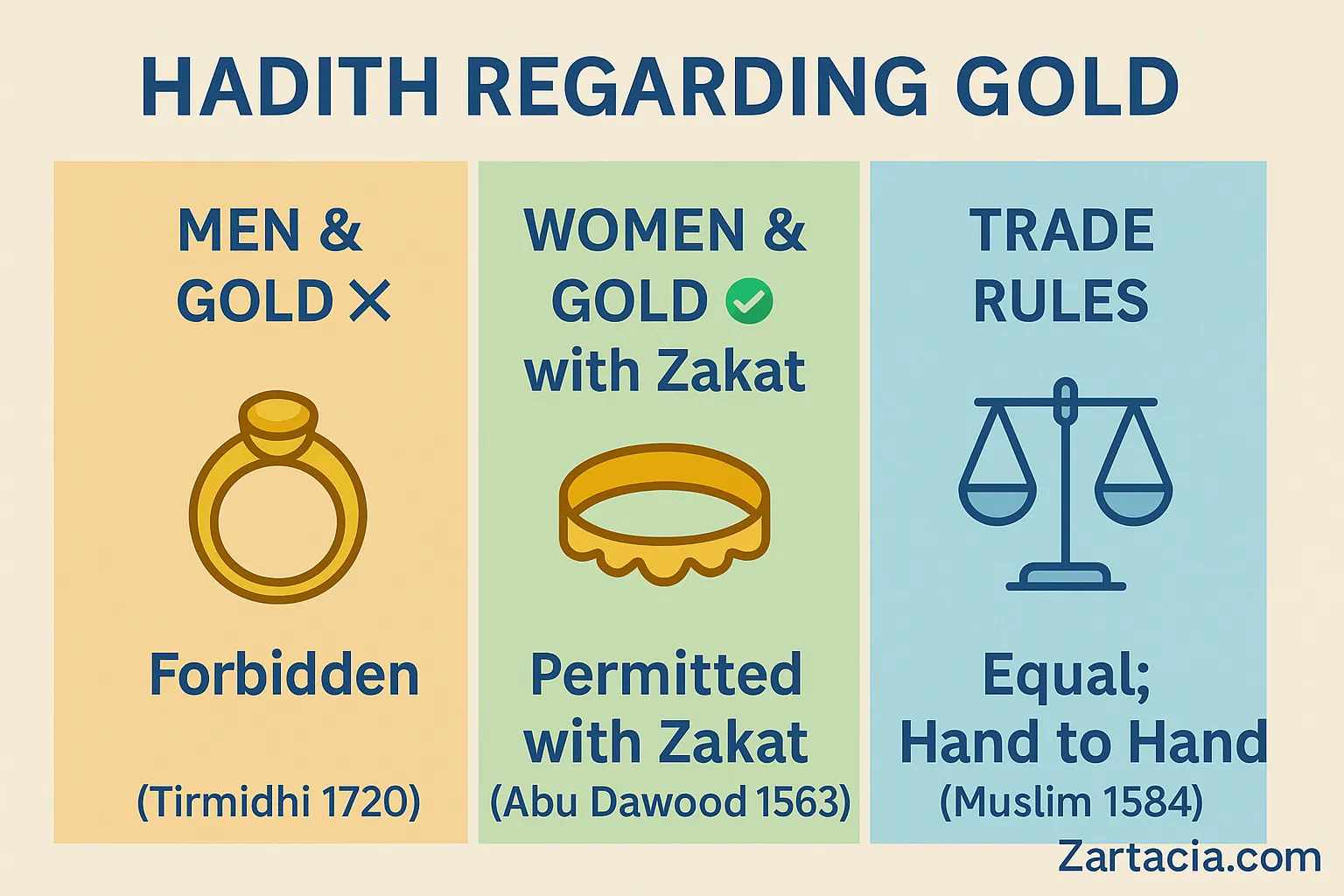
The Prophet ﷺ forbade Muslim men from wearing gold ornaments.
📖 Hadith:
“Gold and silk have been permitted for the females of my Ummah and forbidden for the males.” (Tirmidhi 1720)
This shows that while women may adorn themselves with gold, men are prohibited to wear it as rings, chains, or clothing decorations. The wisdom lies in maintaining modesty, humility, and gender distinction.
Gold and Women – Permissible with Conditions
Women are allowed to wear gold jewelry as adornment, provided they pay Zakat if the amount reaches the Nisab.
📖 Hadith:
The Prophet ﷺ saw two women wearing gold bangles and asked:
“Do you pay Zakat on this?” They replied: “No.” He said: “Would you like Allah to replace them with bangles of fire on the Day of Judgment?” (Abu Dawood 1563)
This Hadith emphasizes that although women may enjoy gold, Zakat is mandatory to purify their wealth.
Trade and Transactions
The Prophet ﷺ gave guidelines about using gold in business:
📖 Hadith:
“Gold for gold, silver for silver… equal for equal, hand to hand. Whoever increases or seeks increase, he has engaged in Riba (usury).” (Muslim 1584)
This ruling prevents unfair profit and exploitation. It teaches that gold should be exchanged fairly and without interest, laying the foundation for Islamic finance.
Ethical Lessons from Hadith on Gold
-
Gold is permissible but must be used with responsibility.
-
Men should avoid gold jewelry, but women may wear it.
-
Zakat on gold ensures fairness and circulation of wealth.
-
Transactions involving gold must be free from Riba.
📚 Student Section
🔹 Summary
-
Men are forbidden from wearing gold.
-
Women can wear gold but must pay Zakat.
-
Gold in trade must follow Islamic rules to avoid Riba.
-
Ethical usage = balance between enjoyment and responsibility.
🔹 Quiz
-
What material is prohibited for men but allowed for women?
-
Which Hadith mentions bangles of fire for women not paying Zakat?
-
What is the ruling about exchanging gold for gold?
-
Why is Zakat important on gold jewelry?
-
How does Islam prevent exploitation in gold trade?
🔹 Difficult Words with Urdu Meanings
| Word | Meaning (Urdu) |
|---|---|
| Prohibition | ممانعت – روک دینا |
| Adornment | زینت – آرائش |
| Riba | سود – ناجائز منافع |
| Obligation | فرض – لازمی عمل |
| Distinction | فرق – امتیاز |
❓ FAQs
Q1: Why is gold prohibited for men in Islam?
Ans: To maintain humility, avoid arrogance, and preserve gender distinction.
Q2: Can women wear gold without restriction?
Ans: Yes, but they must pay Zakat if it reaches the Nisab.
Q3: Is trading gold allowed?
Ans: Yes, but transactions must be equal, hand-to-hand, and free from Riba.
Q4: What happens if someone hoards gold without paying Zakat?
Ans: According to Hadith, it will turn into a source of punishment on the Day of Judgment.
Q5: How do Hadith guide us in modern gold investment?
Ans: By ensuring fair trade, avoiding interest, and fulfilling Zakat obligations.
🔗 read moer:
-
Link to Article 21: Zakat on Gold – Calculation and Nisab
-
Link to Article 22: Hoarding vs Circulation in Islam
-
Link to Article 23: Gold in the Qur’an – Verses and Lessons
🔗 you may like also:
Conclusion
Hadith provide a balanced framework for Muslims on how to deal with gold. Men must avoid it, women can adorn with it responsibly, and business dealings must remain fair. Above all, paying Zakat ensures that gold remains a source of barakah, not burden.
Article no 24