
What Are Gas Fees?
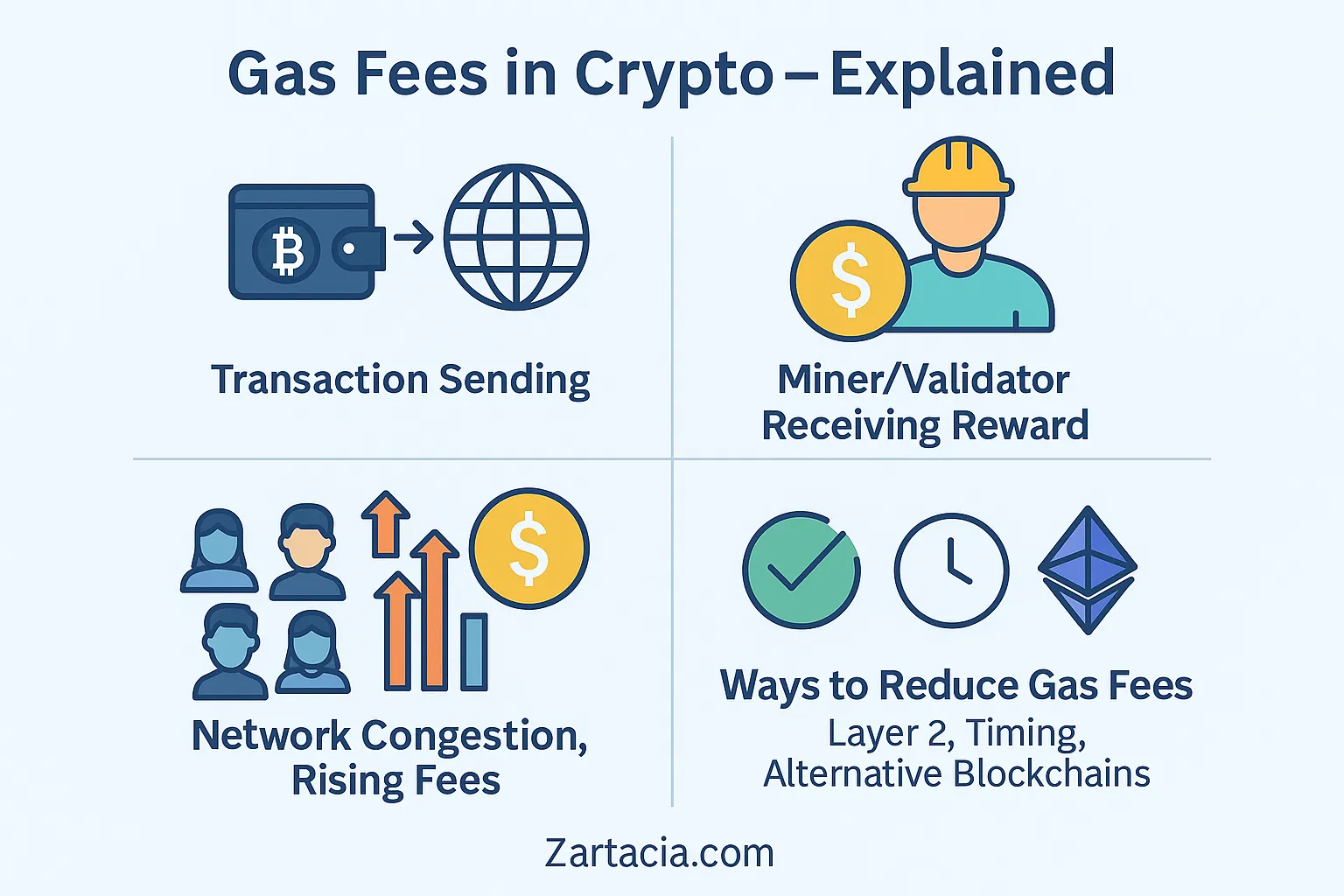
When you send cryptocurrency, buy an NFT, or use a decentralized application (dApp), you often see an extra cost called gas fees. This is not a hidden tax, but the payment you make to the blockchain network for processing your transaction.
Gas fees are like service charges in banks, but instead of going to a company, they go to the network’s participants (miners or validators) who maintain and secure the blockchain.
Why Do Gas Fees Exist?
Blockchains like Ethereum run on thousands of computers worldwide. These computers must verify every transaction. To encourage them, the network offers rewards in the form of gas fees.
-
On Bitcoin: Miners get rewards from block rewards + fees.
-
On Ethereum: Gas fees keep the network secure and prevent spam.
Without gas fees, people could flood the blockchain with fake transactions, slowing down or crashing the system.
How Are Gas Fees Calculated?
Gas fees depend on three main factors:
-
Gas Units: The amount of computational work needed.
-
Gas Price: The cost per unit of gas (decided by supply and demand).
-
Network Traffic: If many people are transacting at once, fees rise.
👉 Example: Sending ETH during a popular NFT launch may cost $50+ in fees, while sending the same ETH at midnight might cost only $2.
Gas Fees on Ethereum
Ethereum uses “gas” to measure computational effort.
-
Simple transaction (sending ETH): Low gas cost.
-
Smart contracts or NFT trades: High gas cost.
-
Congested times: Very expensive transactions.
How to Reduce Gas Fees
-
Choose the right time: Avoid peak hours when the network is crowded.
-
Use Layer 2 Solutions: Platforms like Polygon or Arbitrum offer much cheaper fees.
-
Set Custom Gas Fees: Wallets like MetaMask allow you to choose lower fees (but transactions may be slower).
-
Use Alternative Blockchains: Binance Smart Chain, Solana, or Avalanche often have lower fees.
Student Section
Summary
Gas fees are charges paid to blockchain networks for processing transactions. They ensure security, prevent spam, and reward miners/validators.
Quiz
-
What are gas fees?
-
Why are gas fees important for blockchain security?
-
Name one factor that increases gas fees.
-
Which blockchain is most known for high gas fees?
-
How can you reduce gas fees?
Difficult Words
| Word | Meaning in Urdu |
|---|---|
| Transaction | لین دین |
| Validator | تصدیق کرنے والا |
| Congestion | بھیڑ / رش |
| Computational | حسابی، کمپیوٹر کا عمل |
| Incentive | ترغیب / انعام |
FAQs
Q1. Why are Ethereum gas fees so high?
Because Ethereum handles many complex apps and has heavy network traffic.
Q2. Do Bitcoin transactions have gas fees?
Yes, but they are usually called transaction fees.
Q3. Can gas fees be avoided?
No, but they can be reduced using Layer 2 solutions or cheaper blockchains.
Q4. Who receives the gas fees?
Miners (Proof of Work) or validators (Proof of Stake).
