

Understanding Decentralization
Decentralization is one of the most powerful concepts behind blockchain and cryptocurrency. In simple words, decentralization means that no single person, company, or government fully controls the system. Instead, the power and responsibility are distributed among many participants.
Think about social media platforms like Facebook. They are centralized because one company owns all the data and has full control. In blockchain, however, everyone who participates in the network has a copy of the data. This ensures transparency and reduces the risk of corruption or manipulation.
How Does Decentralization Work?
In a decentralized system, data is stored across thousands of computers (called nodes). Every time a transaction happens, it must be verified by multiple nodes before being approved. This makes cheating or altering data nearly impossible.
-
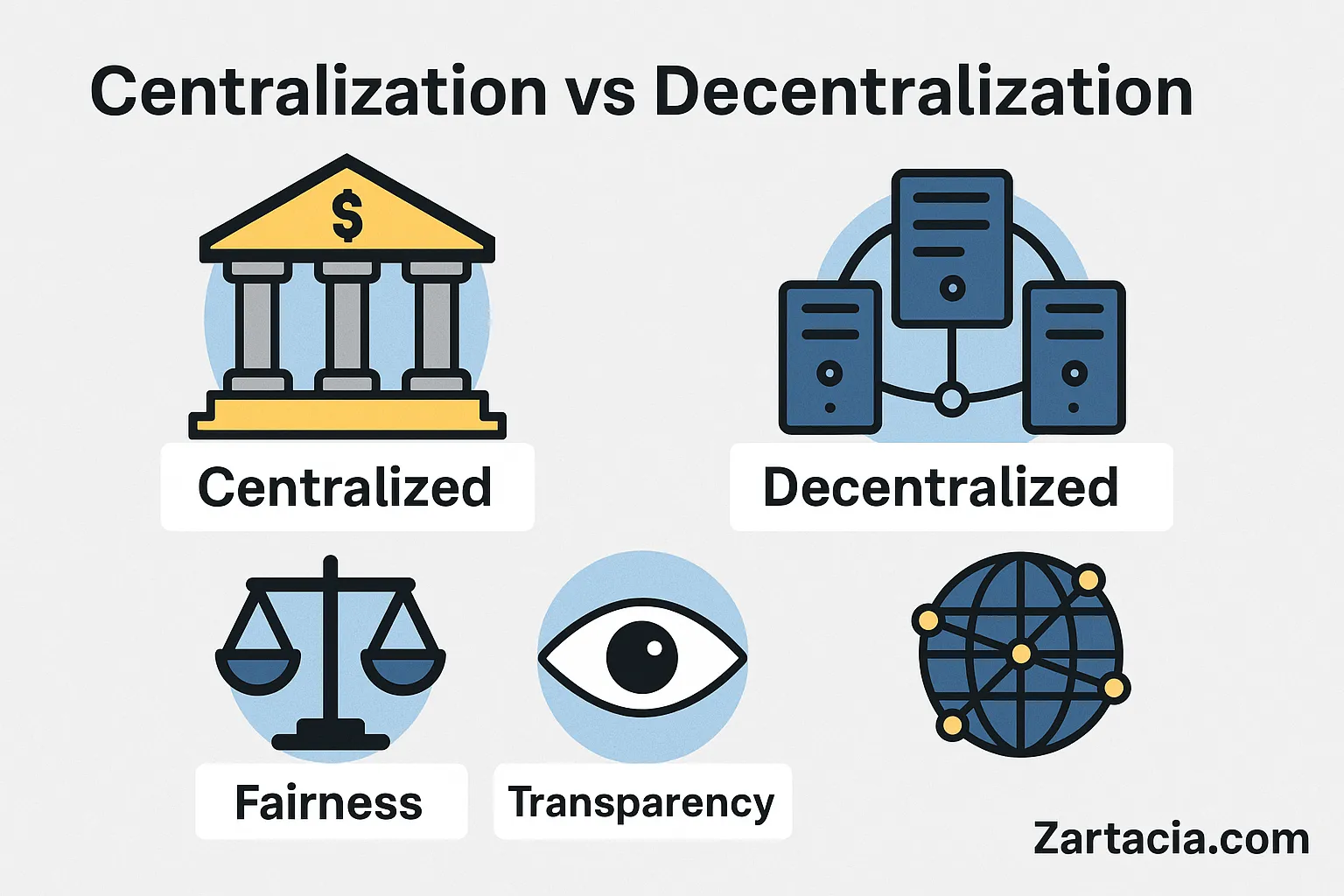
Centralized System: One authority, high risk of abuse.
-
Decentralized System: Multiple authorities, collective trust.
👉 Example: Imagine if only one teacher marked all exam papers, bias could happen. But if 20 teachers check and agree, fairness improves. That’s how decentralization brings trust.
Why Is Decentralization Important?
-
Transparency: Everyone can see the transactions.
-
Security: Hacking one computer doesn’t work; hackers need to hack thousands.
-
No Single Point of Failure: If one server goes down, the system continues.
-
User Freedom: You control your assets, not a company or bank.
-
Trustless Environment: You don’t need to trust a middleman, just the system itself.
Real-Life Examples of Decentralization
-
Bitcoin: No central bank controls it, miners and nodes keep it running.
-
Ethereum: Decentralized apps run without being owned by a single company.
-
Filecoin/IPFS: Data storage controlled by many computers worldwide, not one company.
Centralization vs Decentralization
| Feature | Centralization | Decentralization |
|---|---|---|
| Control | One authority | Distributed among many |
| Risk | High (corruption, hacks) | Low (hard to manipulate) |
| Transparency | Limited | High |
| Example | Bank, Facebook | Bitcoin, Ethereum |
Student Section
Summary
Decentralization means spreading control among many participants instead of one central authority. It makes systems more secure, transparent, and fair.
Quiz
-
What is decentralization in simple words?
-
Give one example of a centralized system.
-
Why is decentralization secure?
-
Name two decentralized projects.
-
What happens if one node fails in a decentralized system?
Difficult Words
| Word | Meaning in Urdu |
|---|---|
| Authority | اختیار، طاقت |
| Manipulation | ہیرا پھیری، چالاکی |
| Transparency | شفافیت |
| Trustless | بے اعتماد ماحول |
| Distributed | تقسیم شدہ |
FAQs
Q1. Does decentralization mean no rules?
No, it means rules are followed collectively, not controlled by one entity.
Q2. Can decentralization fail?
If very few participants are active, centralization risks can reappear.
Q3. Why do investors prefer decentralized systems?
Because they reduce manipulation and increase trust.
Q4. Is decentralization only for crypto?
No, it can also be applied in supply chains, voting, and communication.
Read More
-
What is Cryptocurrency? Beginner’s Guide