

Tokens vs Coins – A Beginner’s Explanation
When people first enter the world of cryptocurrency, they often get confused between coins and tokens. These two words are used so frequently that many think they mean the same thing. But in reality, there are clear differences between the two, and understanding them is essential for every beginner in crypto.
What is a Coin?
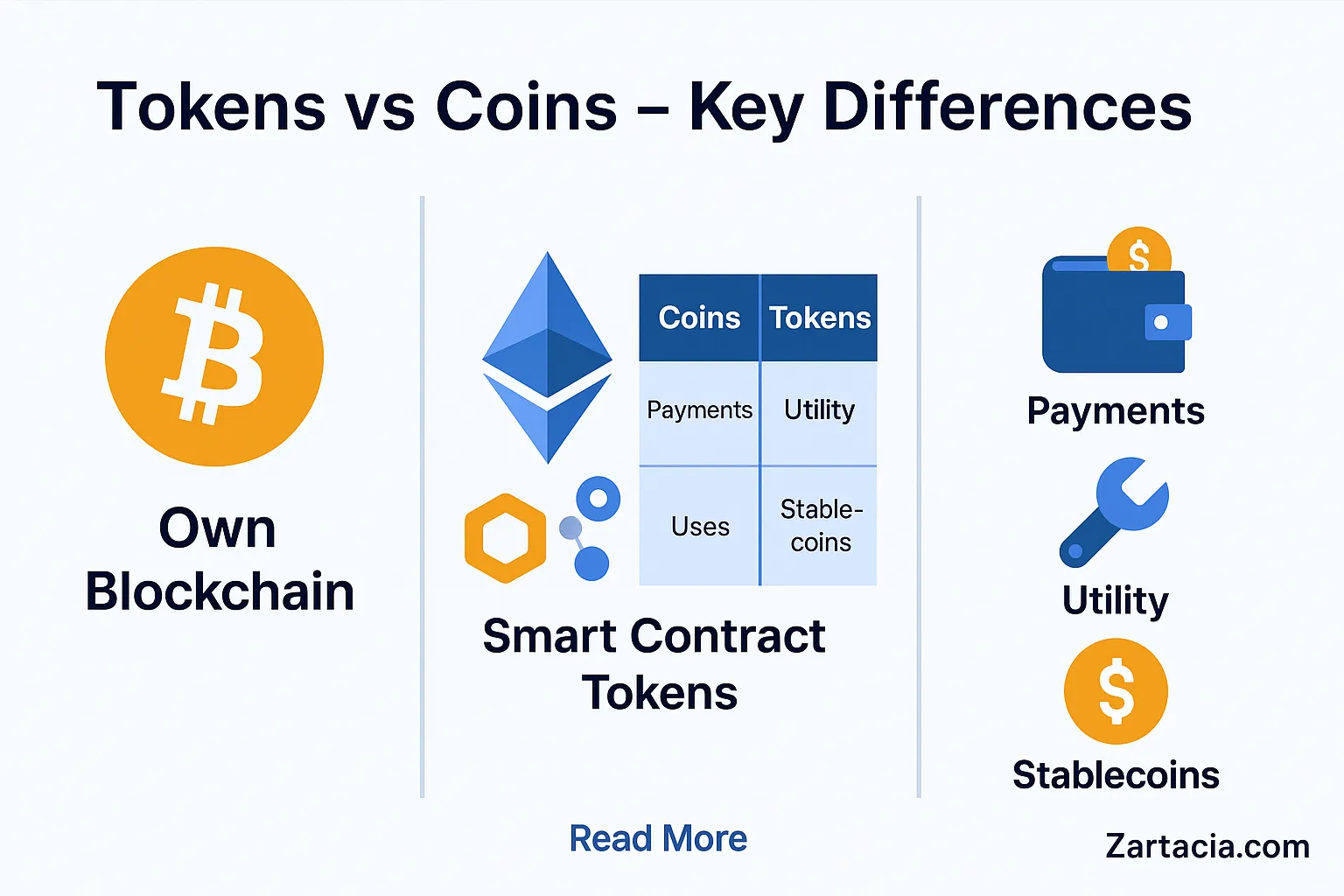
A coin is a cryptocurrency that operates on its own blockchain. Bitcoin, for example, has its own blockchain. Ethereum also has its own blockchain. These coins are native to their networks, and they usually serve as:
-
Digital money: Used for payments and transactions.
-
Network fees: Paying transaction fees (e.g., ETH for Ethereum).
-
Store of value: Some coins are considered digital gold, like Bitcoin.
👉 Simple Example: If Bitcoin is like the official currency of a country, then Bitcoin’s blockchain is like that country’s banking system.
What is a Token?
A token is a cryptocurrency built on top of an existing blockchain. Tokens do not have their own blockchain but rely on another network like Ethereum, Binance Smart Chain, or Solana.
Tokens are usually created for specific purposes such as:
-
Utility Tokens: Used inside an app or ecosystem (e.g., UNI for Uniswap).
-
Security Tokens: Represent shares or assets in digital form.
-
Stablecoins: Tokens pegged to stable assets like USDT or USDC.
👉 Example: A video game company builds a digital coin for in-game purchases. That token runs on Ethereum blockchain, not on its own chain.
Main Differences Between Coins and Tokens
| Feature | Coins (e.g., BTC, ETH) | Tokens (e.g., USDT, UNI) |
|---|---|---|
| Blockchain | Have their own | Built on another blockchain |
| Use Case | Payments, fees, store value | Utilities, assets, stable value |
| Example | Bitcoin, Ethereum, Solana | Uniswap, Chainlink, Tether |
| Creation | Hard to create (need chain) | Easy via smart contracts |
Why Does This Difference Matter?
For investors and developers, knowing the difference between coins and tokens is critical.
-
Investment Strategy: Coins often represent stronger, long-term projects.
-
Development: Tokens make it easier for startups to launch digital products.
-
Regulation: Governments treat coins and tokens differently depending on their nature.
Student Section
Summary
Coins are native digital currencies with their own blockchain (like Bitcoin, Ethereum). Tokens are built on top of other blockchains for specific uses (like USDT or UNI).
Quiz
-
What is the main difference between a coin and a token?
-
Give two examples of coins.
-
Give two examples of tokens.
-
What type of token is USDT?
-
Why are tokens easier to create than coins?
Difficult Words
| Word | Meaning in Urdu |
|---|---|
| Native | اصل، بنیادی |
| Ecosystem | نظام، ماحولیات |
| Utility | استعمالی فائدہ |
| Regulation | ضابطہ، قانون |
| Pegged | جڑا ہوا، منسلک |
FAQs
Q1. Is Ethereum a coin or a token?
Ethereum is a coin because it has its own blockchain.
Q2. Is USDT a coin or token?
USDT is a token because it runs on other blockchains like Ethereum.
Q3. Can a token become a coin?
Yes, if developers build a new blockchain for it.
Q4. Which is safer: coins or tokens?
Both can be safe, but coins are usually more established.