How Search Engines Work (Google, Bing, Yahoo)
Search engines are the backbone of the internet. Whenever you type a query into Google, Bing, or Yahoo, millions of websites compete to appear on the first page. But how do these search engines actually decide which pages to show first? Understanding this process is essential for anyone interested in digital marketing and SEO.
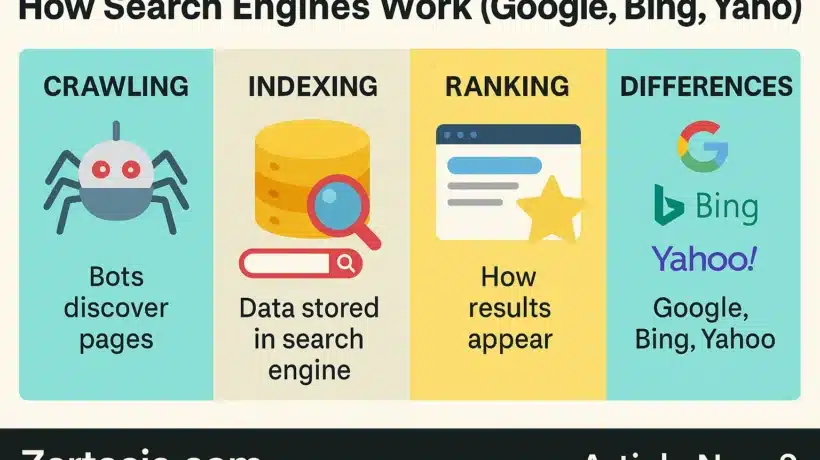
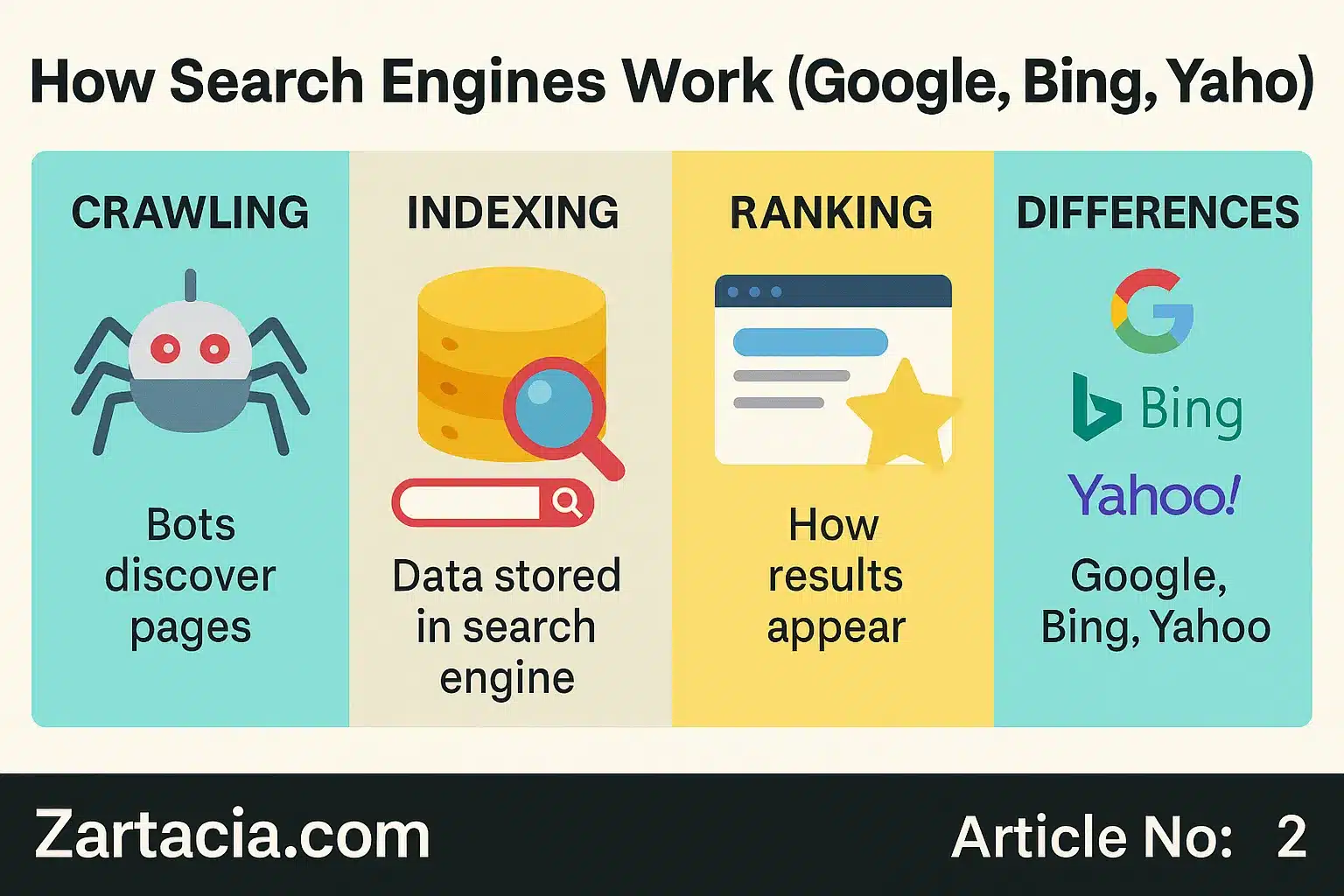
Search engines function like digital librarians. They constantly scan the web, organize information, and deliver the most relevant results within seconds. The steps they follow—crawling, indexing, and ranking—determine the visibility of websites.
In 2025, search engines have become even more sophisticated. They don’t just look at keywords; they analyze user intent, context, and trust signals. For businesses, bloggers, and beginners, knowing how search engines work provides the foundation for building SEO strategies that succeed in the long run.
Crawling – How Bots Discover Pages
Crawling is the first step in the search engine process. Bots, also called crawlers or spiders, move through the internet by following links from one page to another. They discover new websites, updated content, and pages that may have changed.
For example, when you publish a new article on your website, Google’s crawler will eventually visit your site and “read” the content. Internal links help crawlers move easily from one page to another, while external backlinks alert them about your existence.
However, not all pages are crawled. Pages with broken links, blocked by robots.txt, or hidden behind logins may remain invisible to search engines. This is why technical SEO is important—ensuring your site is crawlable improves visibility.
Indexing – How Data is Stored
After crawling, the next step is indexing. Indexing is like adding a book into a massive digital library. Search engines take the information from your page and store it in their database.
During indexing, the system looks at:
-
Page titles and meta descriptions
-
Keywords and topics
-
Images and alt text
-
Mobile-friendliness and usability
For instance, if your article is about “best laptops 2025,” search engines will try to understand its relevance, store it under the correct category, and compare it with other similar articles.
If a page isn’t indexed, it will never appear in search results. This is why submitting an XML sitemap to Google Search Console is a key SEO practice.
Ranking – How Search Results Appear
Ranking is the final step where search engines decide the order of results. Google alone uses over 200 ranking factors, including content quality, backlinks, site speed, mobile usability, and user engagement.
For example, if two websites write about “digital marketing,” the one with better authority, faster loading speed, and higher-quality backlinks will rank higher. Google’s algorithm updates (like Core Web Vitals) further refine this process, ensuring users get the best experience.
Bing and Yahoo use similar ranking principles but with slight differences. Bing often places more weight on social signals, while Yahoo integrates results with its partnership with Bing.
Ranking is dynamic—results can change daily depending on competition, new content, or algorithm changes.
Differences in Google, Bing, Yahoo
-
Largest search engine (90%+ market share)
-
Focuses heavily on user intent and quality signals
-
Uses AI-driven updates like RankBrain and BERT
Bing
-
Powers Yahoo search results
-
Strong emphasis on multimedia (images, videos)
-
Values exact-match keywords slightly more than Google
Yahoo
-
Once a leader, now depends on Bing for most search results
-
Offers additional services like Yahoo News and Finance
-
Has a smaller market share but still relevant in specific regions
Understanding these differences helps SEO professionals adapt their strategies depending on which audience they target.
Student Section
✅ Summary (150 words)
Search engines work in three main steps: crawling, indexing, and ranking. Crawlers discover web pages by following links. Indexed pages are stored in the search engine’s massive database. Finally, ranking algorithms decide which results appear first. In 2025, Google, Bing, and Yahoo are smarter than ever, focusing on user intent, trust, and quality. Google dominates the market with AI-driven ranking, while Bing emphasizes multimedia and Yahoo leverages Bing’s search infrastructure. For businesses, understanding this process is crucial. Without proper crawling, indexing, and ranking, even the best website may remain invisible. Knowing how search engines work ensures your content is discoverable, stored correctly, and ranked higher in results.
📝 Quiz
-
What is the first step of how search engines work?
Answer: Crawling. -
What does indexing mean in SEO?
Answer: Storing web page data in the search engine’s database. -
Which search engine has the largest global market share?
Answer: Google. -
What does Bing emphasize more than Google?
Answer: Multimedia content and social signals. -
What happens if a page is not indexed?
Answer: It will not appear in search results.
Difficult Words Table
| Word | Meaning in Urdu |
|---|---|
| Crawling | ویب صفحات کو تلاش کرنا |
| Indexing | ڈیٹا کو ذخیرہ کرنا |
| Algorithm | حسابی طریقہ کار |
| Visibility | نمایاں ہونا |
| Ranking | درجہ بندی |
FAQs
Q1: How often do search engines crawl websites?
It depends—popular sites may be crawled daily, while smaller sites may take days or weeks.
Q2: Can I request Google to crawl my website faster?
Yes, you can use Google Search Console’s URL Inspection tool to request indexing.
Q3: Why does my site appear on Bing but not on Google?
Different algorithms and indexing policies can cause variations. Ensuring technical SEO is correct helps.
Q4: Are search engines the same worldwide?
No, in countries like China (Baidu) and Russia (Yandex), local search engines dominate.
People are also reading
-
“On-Page SEO Checklist for Beginners”
-
“Why Every Business Needs SEO in 2025”
-
“Hosting vs Domain – Beginners Guide”