
Bounce Rate & SEO – The Connection Explained
Focus Keyphrase: Bounce Rate and SEO
Meta Title: Bounce Rate & SEO – Connection Explained 2025
Meta Description: Learn how bounce rate impacts SEO in 2025. Discover causes, effects, and strategies to reduce bounce rate for higher rankings.
Slug: bounce-rate-and-seo-connection
Category & Subcategory: SEO → On-Page SEO
Tags: bounce rate, SEO metrics, reduce bounce rate, dwell time SEO, user engagement
Introduction
A visitor lands on your website, looks at one page, and then leaves without interacting further. This is called a bounce. The percentage of such visitors is your bounce rate. For years, marketers have debated whether bounce rate directly impacts SEO rankings.
In 2025, Google has clarified that while bounce rate itself is not a direct ranking factor, it strongly reflects user experience signals like relevance, engagement, and satisfaction. A high bounce rate often means users didn’t find what they were looking for, which indirectly affects rankings.
This article explores what bounce rate is, why it matters, and how to reduce it to improve your SEO performance.
What is Bounce Rate?
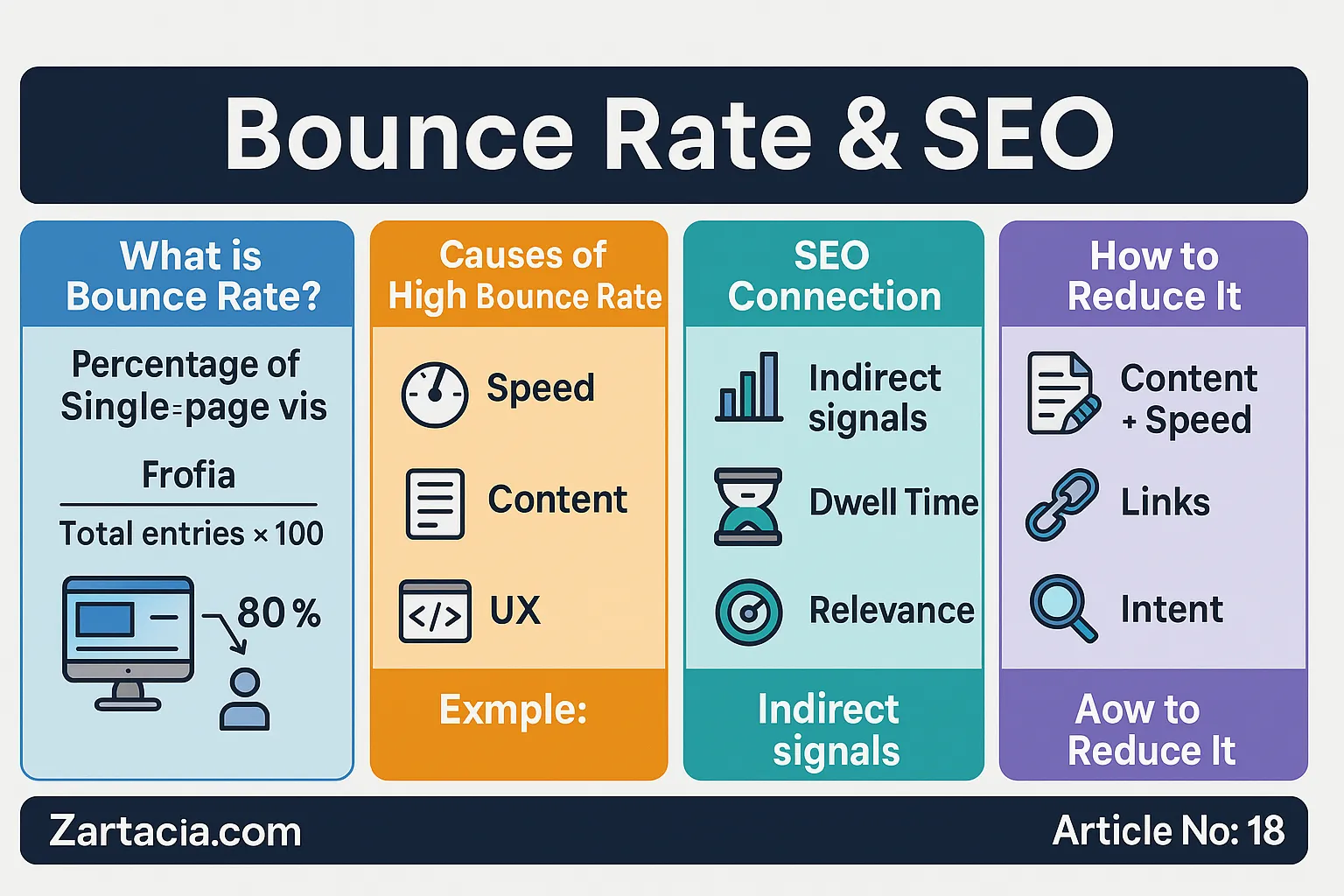
Bounce rate is the percentage of visitors who leave your website after viewing only one page, without clicking further.
Example: If 100 people visit a blog post and 70 leave without engaging, the bounce rate is 70%.
Formula:
Bounce Rate = (Single-page visits ÷ Total entries) × 100
Causes of High Bounce Rate
-
Slow Page Speed – If your site takes more than 3 seconds to load, users may leave.
-
Poor Content Quality – Thin, irrelevant, or outdated content drives users away.
-
Bad User Experience – Difficult navigation, intrusive pop-ups, or poor mobile design.
-
Wrong Audience – Targeting irrelevant keywords brings traffic that doesn’t engage.
-
Technical Issues – Broken links or errors can push visitors out.
Case Study: A website with a 78% bounce rate reduced it to 52% by improving page speed and adding interactive content.
How Bounce Rate Affects SEO
-
Not a Direct Ranking Factor – Google doesn’t use bounce rate from Analytics as a ranking metric.
-
Indirect Signals – High bounce rate often correlates with low dwell time, which Google does consider.
-
User Intent Mismatch – If visitors leave quickly, Google may assume your page isn’t relevant.
-
Brand Trust – High bounce rates can damage brand credibility.
Ways to Reduce Bounce Rate
-
Improve Content Quality – Write detailed, engaging, and updated articles.
-
Boost Page Speed – Use caching, compression, and CDN.
-
Enhance Design – Mobile-friendly, clean layouts with easy navigation.
-
Add Internal Links – Guide readers to other relevant pages.
-
Match Search Intent – Ensure your content delivers exactly what users are searching for.
Example: Adding “related articles” reduced bounce rate by 25% on a blog site.
Student Section
Summary
Bounce rate measures the percentage of visitors who leave a site after viewing only one page. While it’s not a direct Google ranking factor, it reflects important SEO signals such as relevance, user experience, and content quality. High bounce rates usually mean visitors didn’t find the information they needed, the site loaded slowly, or the design was confusing. To reduce bounce rate, website owners should focus on high-quality, engaging content, fast page loading, mobile-friendly design, and strategic internal linking. Matching search intent is also crucial, ensuring users get exactly what they expect. By reducing bounce rate, businesses can improve user engagement, boost dwell time, and indirectly strengthen SEO rankings. A lower bounce rate signals that users are satisfied, which builds credibility and trust with both visitors and search engines.
📝 Quiz
-
What is bounce rate?
Answer: The percentage of visitors leaving after viewing one page. -
Is bounce rate a direct ranking factor?
Answer: No, but it affects SEO indirectly. -
Name one cause of high bounce rate.
Answer: Slow page speed. -
How can internal linking reduce bounce rate?
Answer: By guiding users to more content. -
What is dwell time?
Answer: The time a visitor spends on a page before leaving.
📘 Difficult Words Table
| Word | Meaning in Urdu |
|---|---|
| Bounce | واپس جانا / چھوڑ دینا |
| Dwell Time | قیام کا وقت |
| Intrusive | زبردستی مداخلت کرنے والا |
| Credibility | ساکھ / اعتماد |
| Relevance | مطابقت / تعلق |
FAQs
Q1: What is a good bounce rate?
Around 40–55% is considered average. Under 40% is excellent.
Q2: Can blogs have higher bounce rates?
Yes, blogs often have higher bounce rates since users read one article and leave.
Q3: Does bounce rate affect conversions?
Yes, high bounce rates mean fewer chances to convert visitors into customers.
Q4: How do I track bounce rate?
Use tools like Google Analytics or GA4 Engagement metrics.
People are also reading
-
“Internal Linking vs External Linking – Best Practices”
-
“Image SEO – How to Optimize Images for Google”
-
“Content Length vs Quality – What Google Prefers”
