LSI Keywords – What They Are & How to Use Them
Search engines have evolved far beyond simple keyword matching. Today, Google focuses on understanding context and meaning. That’s where Latent Semantic Indexing (LSI) keywords come in.
In 2025, Google uses Natural Language Processing (NLP) and AI to evaluate how words relate to each other. By adding LSI keywords—related terms and synonyms—you help Google understand your content better, making it more likely to rank for multiple queries.
This article explains what LSI keywords are, why they matter, and practical ways to use them in your SEO strategy.
What are LSI Keywords?
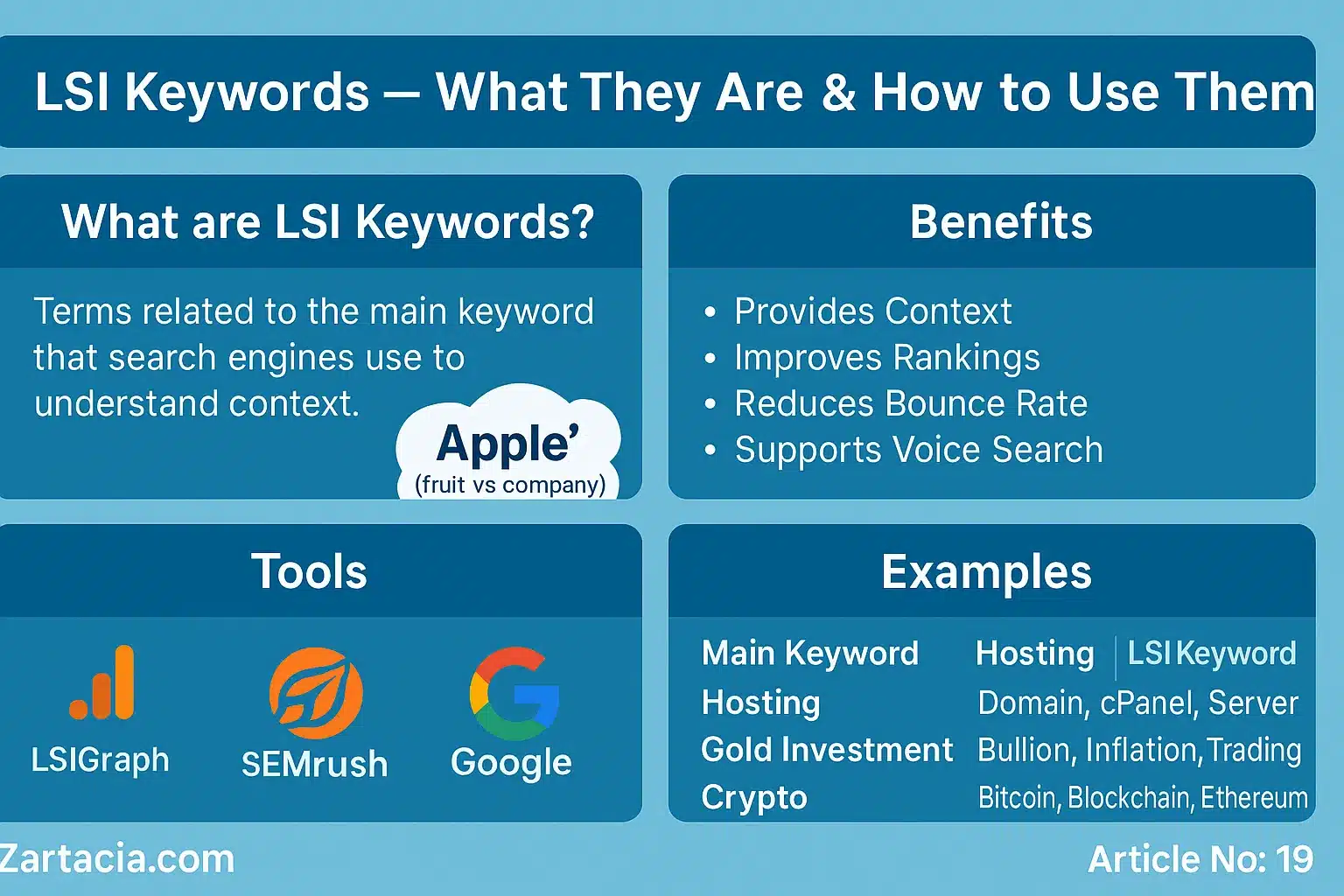
LSI keywords are conceptually related terms that search engines use to understand context.
Example: For the keyword “Apple” →
-
LSI terms could include iPhone, iPad, Mac, fruit, technology, company.
They tell Google whether your page is about Apple (the fruit) or Apple (the company).
Unlike keyword stuffing, LSI keywords improve natural flow and help content rank for multiple variations.
Benefits of Using LSI Keywords
-
Better Context – Google understands what your page is really about.
-
Improved Rankings – Increases chances of appearing for multiple queries.
-
Reduced Bounce Rate – Content appears more relevant to users.
-
Avoids Over-Optimization – Prevents spammy keyword stuffing.
-
Voice Search Optimization – Matches natural conversational queries.
Example: A blog on “best SEO tools” that also uses LSI terms like analytics, backlinks, keyword research ranks for broader searches.
Tools to Find LSI Keywords
-
Google Autocomplete – Suggestions while typing.
-
Google Related Searches – Found at the bottom of SERPs.
-
LSIGraph – Free tool for LSI keyword ideas.
-
SEMrush / Ahrefs – Professional keyword research tools.
-
AnswerThePublic – Generates common questions and related terms.
Practical Examples
-
Main Keyword: Hosting
-
LSI Keywords: domain, cPanel, cloud, speed, server, uptime
-
-
Main Keyword: Gold Investment
-
LSI Keywords: bullion, inflation hedge, jewelry, trading, reserves
-
-
Main Keyword: Crypto
-
LSI Keywords: Bitcoin, blockchain, Ethereum, wallet, mining
-
Adding these LSI terms makes your content semantically stronger.
Student Section
✅ Summary
LSI keywords are related terms that help search engines understand the context of your content. In 2025, Google relies on NLP and AI, making semantic SEO more important than ever. By using LSI keywords naturally within content, websites can rank for multiple search variations, improve relevance, and reduce bounce rates. LSI keywords differ from primary keywords because they don’t replace them; they add depth and context. Tools like LSIGraph, SEMrush, Ahrefs, and AnswerThePublic make it easier to discover relevant LSI terms. For example, an article about “hosting” can also include related words like domain, cPanel, server, and uptime. Using LSI keywords prevents keyword stuffing, supports voice search optimization, and improves user experience. Overall, LSI keywords ensure content aligns with user intent, boosting both visibility and engagement.
📝 Quiz
-
What does LSI stand for?
Answer: Latent Semantic Indexing. -
What is the main benefit of LSI keywords?
Answer: They provide context for search engines. -
Name one tool for finding LSI keywords.
Answer: LSIGraph (or SEMrush, Ahrefs, AnswerThePublic). -
Do LSI keywords replace main keywords?
Answer: No, they complement them. -
Give an LSI keyword for “Hosting.”
Answer: Server, cPanel, or uptime.
Difficult Words Table
| Word | Meaning in Urdu |
|---|---|
| Semantic | معنوی / معنی پر مبنی |
| Context | سیاق و سباق / پس منظر |
| Synonyms | مترادف الفاظ |
| Indexing | اندراج / فہرست میں شامل کرنا |
| Over-Optimization | حد سے زیادہ آپٹیمائزیشن |
FAQs
Q1: Are LSI keywords still relevant in 2025?
Yes, they remain important for context and semantic SEO.
Q2: Should I force LSI keywords into content?
No, use them naturally within sentences.
Q3: Do LSI keywords help with voice search?
Yes, because they match natural conversational patterns.
Q4: How many LSI keywords should I use per article?
3–6 well-placed terms are usually enough.
People are also reading
-
“Bounce Rate & SEO – The Connection Explained”
-
“Internal Linking vs External Linking – Best Practices”
-
“Content Length vs Quality – What Google Prefers”
